
Good evening everyone and welcome back. Tonight Amanda, Hector, Eddie and I sat down for a game of Dead Reckoning, a card crafting pirate game by John D Clair. I had meant to review this game back when we first played but for some reason we never got around to it. Fear not, the review is in and although we did not take pictures from this playthrough, the ones from the review playthrough are still on my computer so we are good to go. Amanda and I are both fans of John D Clair’s games, especially the card crafting system, but does dead Reckoning live up to the standard set by the others? Read on to find out.

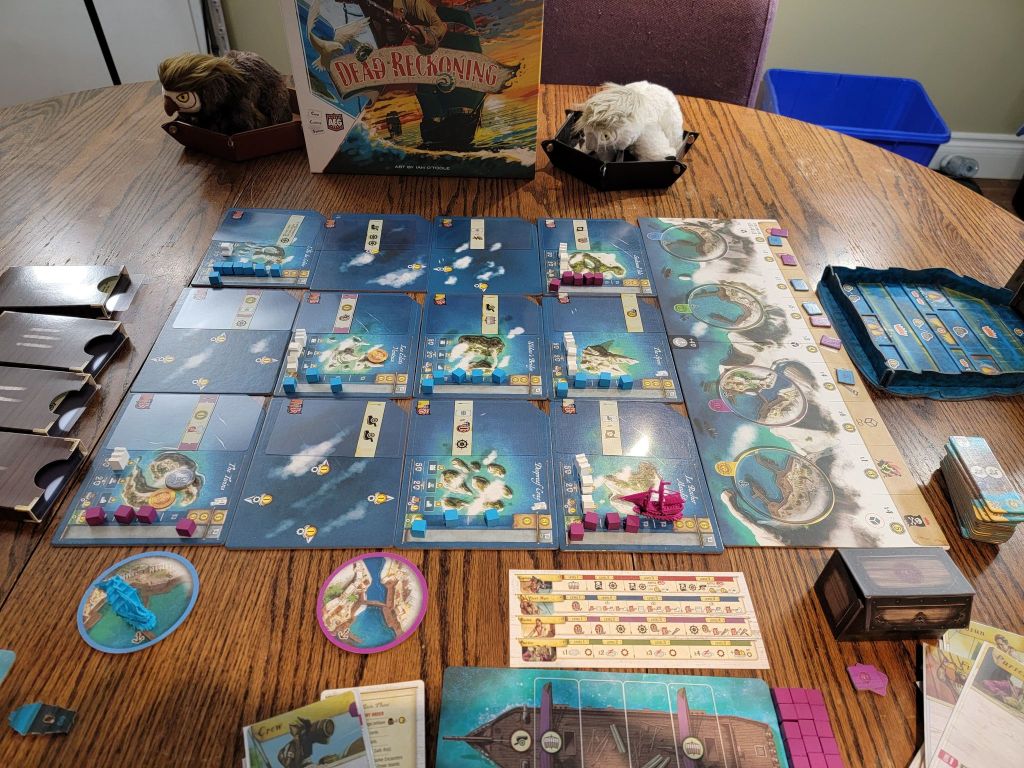
Beginning as usual with the components, I will say that before we even get into the kickstarter bonuses, they are stellar. The art is excellent and thematic throughout, from the box to the board to the cards and tokens. The cardboard is strong and punches well, the acetone cards are great and the box not only comes with snazzy storage components for everything but has detailed instructions on the inside of the lid showing how to easily fit it all back in the box. Other designers take note, there is absolutely no reason not to include this if your components are in any way complicated to store, and it really needs to become the industry standard.
With all the good comes a little bit of bad. The first part is the cubes, which although of fine quality and fit to purpose, really pale in comparison to everything else, the only reason they are there is to facilitate the second problem I have with the components and it’s a bit of a doozy. I mentioned before that I like John D Clair as a designer, and I certainly do, the man seems to have a phobic aversion to using dice for randomness. To “roll” combats in Dead Reckoning, you toss cubes into a ship shaped cube tower thingy and see where they land on a board when they come out the bottom. Now admittedly it looks pretty cool, but it basically serves the role of a set of dice except it does everything considerably worse, while taking up more place than a player in a game that already has a substantial table footprint. John please, leave out the gimmicky random stuff, we like dice. We will pay good kickstarter money for you to put nice custom dice in your games, I’m begging you, please, embrace the dice.

Minor quibbles about the components aside, the real question is, how does it play? In Dead Reckoning, players each start in port with an unrevealed board of 12 tiles and a basic crew of 12 cards, each at level 1. There is a lot to the game so I will not get into a detailed explanation but on a players turn they can move, generate barrels (which are the generic resource of the game), explore, take over and build on islands, resolve encounters, purchase advancements, upgrade their ship, produce goods and gold on islands and generally go about pirating the high seas. Also after a player’s turn has ended but before their next begins, they will upgrade on of their crew to the next level.
Gold is the stand in for victory points and is earned through both plunder and production, and can be taken from other players and gameboard merchant ships or produced and picked up from player controlled islands. Nearly every upgrade is also worth some sort of victory points at the end of the game, and there are several specific ones that can really boost your final score. Players will also compete for milestones, and once a single player has hit 4 of them, all other players get one final turn before endgame scoring.
Dead Reckoning has a lot of moving parts and is essentially a pirate sandbox point salad game, which might turn some off at first glance but I find a positive. There are many viable paths to victory. With that being said, some of the choice is an illusion, if you choose to just play around in the sandbox and let other players do the same, they can run away with the game. Player interaction can be either very high or minimal depending on playstyle, but it’s nearly mandatory to step in and start plundering the lead player’s islands or ships at some point. A certain amount of aggression is necessary, but too much can leave you full of upgrades but lacking other scoring opportunities. In short, a more balanced approach is needed and players who choose to dabble in all of the point salad while strengthening themselves across a couple fronts will generally fare better than those who choose to go hard into just building on islands or exploration. Whether this is a positive or negative will depend on the player’s preferences.
What I like most about the game is that there is constant escalation, and the game will continue ramping up to the conclusion, which tends to be epic. Rivalries involving a cube or two being fired back and forth in the first turns finish with a half dozen attacks per side being fired. Near the end game, each combat can decide the ownership of an island or sink an enemy ship in a single round. Because every player gets at least one upgrade every turn, and the board constantly refilling with more for purchase, the endgame has a completely different flavor than the beginning and really allows the theme to shine. The only buccaneer activity left out is hand to hand combat, and honestly, with so much else going on, it’s hardly missed.

Overall I have to give Dead Reckoning a strong recommendation. the mechanical foundation of the game is very solid and the theme is strong and well represented by the mechanisms, even the completely unnecessary ship cube tower. It’s not a short game, but because of the constant escalation, it doesn’t wear out it’s welcome. The two player game is a oddly enough a little bit looser than the 4 player game. Although there are less islands to fight over, the number is not really reduced in proportion to the number of players, so each player actually has a lot more freedom. The overall feel of the game remains unchanged, and if you like it at 4, you will probably like it at 2.
I’ll add a breif note since this was meant to be an initial review, but this playthrough came after including some expansion content. The main expansions or “sagas” are a legacy style batch of additions to the game. There is very little content added to the game at first and more boxes and envelopes are opened and added as content is discovered in game (no content is stickered or destroyed though, so the saga’s can be “reset” when done). I personally enjoy this but I would also recommend that experienced gamers immediately add the expansion content from the get go, and newer gamers add it after a game or two. It’s both random and fairly slow burn so unless you are playing Dead Reckoning quite frequently, you will never see most of it if you introduce it at any pace other than the “lots of saga” recommendation in the boxes.
The Teal Deer
Designer: John D. Clair
Price: $80 Base, $60 per expansion. Generally only available through kickstarters or secondary market.
Players: 1-4
2 player Scaling: Decent, plays best with 4.
Playtime: 90-180 minutes
Estimated Lifespan: In permanent collection
Estimated Average Play Frequency: Quarterly
Complexity: 4.5
Components: 5
Bang for Buck: 5
Value for Time: 4
Fun Factor: 4.5
Overall: 5
 Cardboard for 2
Leave a comment