
Good evening everyone! Earlier this evening Amanda and I were joined by our ever-faithful owlbears Hector and Eddie for a game of Ark Nova. Rave reviews of this game, often compared to Terraforming Mars, have been making the rounds online and it wasn’t easy to get a hold of until now. Can the game some have dubbed “Terraforming Zoo” hold up to one of the greatest engine building games of all time? Read on to find out.
Starting as always with a review of the components, I’ll have to say that they are mediocre, but functional, very comparable to terraforming mars on it’s original release actually. The cards are a gloss finish, which is not bad in and of itself, but the central deck is massive and a linen finish would have been far more comfortable to shuffle. The cardboard is not flimsy per se, but it’s not top quality either and there were several delaminations when punching the tokens out, though luckily no ripping of the printed side. The token trays included are nice, but really flimsy and not particularly well fitted to the components, nor do they close well. I wouldn’t wish Kickstarter level bloat upon Ark Nova, but I do hope it’s popularity and success lead to some quality of life improvements over time as happened to Terraforming Mars, it cries out for some upgrading or a deluxe edition.
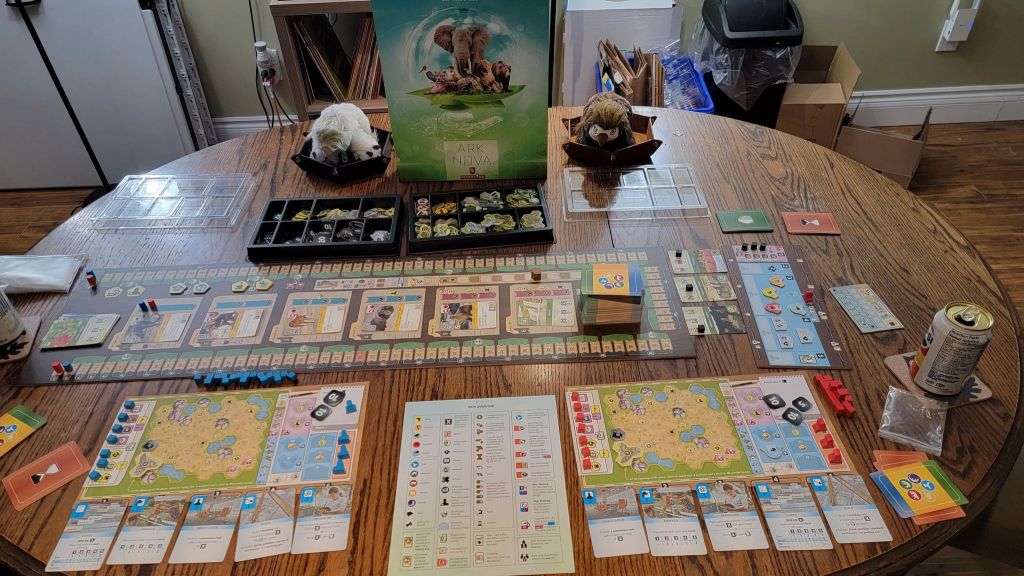
The graphic design, in contrast to the components, is extremely well done. There is a lot of iconography going on, but it’s generally quite clear and well represented on the board, and the included quick reference sheet made it so we never needed to look anything up in the rulebook on our first playthrough. All of the actions on the board are also color coded so it is very easy to tell which ones required upgraded actions to use, which is a very well thought out design choice. The card art is decent, with a good variety of animals represented without interfering with the functional aspects of the cards, overall very well done.
As for the gameplay of Ark Nova, it’s an engine builder that uses cards and maps, and this is about where the comparison to Terraforming Mars will end. Ark Nova’s turns are driven by an interesting little action selection board at the bottom of the player’s tableau, with cards being stronger the further they are to the right of the board, but returning to the lowest place on the left each time they are used. It’s an excellent system that rewards both tactical and strategic planning, and it really deserves all the praise it’s been given.
There is a lot of things to do in the game, so my gameplay summary will be far from exhaustive. A players turn consists of choosing and activating one of their action cards, which perform the various game tasks, and have a more useful effect the further to the right they currently sit in the tableau. Most of these either increase your score or build your engine and include things such as; building new buildings in the tableau, drawing cards, playing animals into the zoo, sponsor or conservation cards, doing association actions and so on. There are two “scores” the first being appeal, which governs your income and is mainly increased by adding animals, and conservation, which provides miscellaneous bonuses and is slowly but steadily increased through various game actions. The score tracks start on opposite ends of the board and when the two meet for any player, this triggers the end game, with final score being determined by the distance between the two scores.
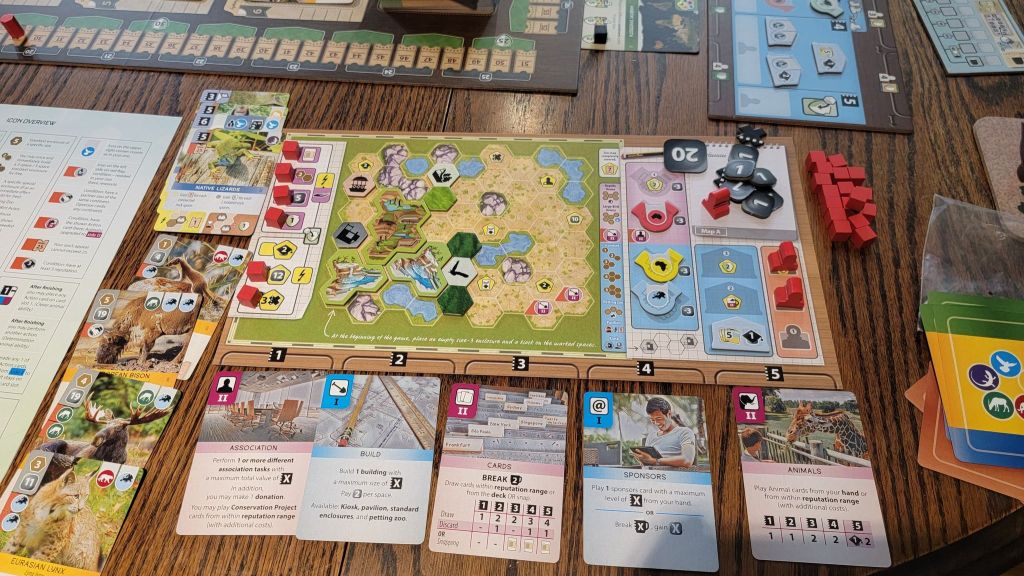
Ark Nova manages to create a great balance between engine building and action selection, constantly making the players think of whether or not each action should be used to expand or upgrade the tableau and engine, or to start focusing on points. All the actions can be upgraded and advancing things like research or filling out your zoo board provide more and more options to improve your engine, but very few cards and actions score. This is not one of those games where you get bonus points for having a lot of money or animals or anything else at the end of the game. There are a few endgame scoring sponsor cards, but everything else needs to be converted to either appeal or conservation to be useful. That being said it’s still plenty of fun just to build up your zoo and fill it with cool animals, there are no “bad” cards, you just need to figure out which ones are most useful to the engine you are building.
The lack of formal rounds was a very interesting design choice and works very well. There is a “break” track represented by a coffee cup on the board and it does not move except when triggered by certain player actions, with a fairly standard board refresh and income phase happening when it reaches the end. This makes for an interesting mechanic where players can either try to maximize their actions between breaks, or a player who might want income purposefully trying to trigger it as fast as possible. Overall it’s a very choice filled game and not great for those prone to analysis paralysis, but the generally slower pace of board refreshing allows one to think a few turns ahead in turns of strategy without worrying about your options being wiped off the board before your turn.
I can’t see much difference in gameplay between the different player counts, the way the game scales seems to change very little other than the time it will be on the table for, it’s not a short game and I wouldn’t want to teach it to 3 new players in one sitting, that’s for sure.
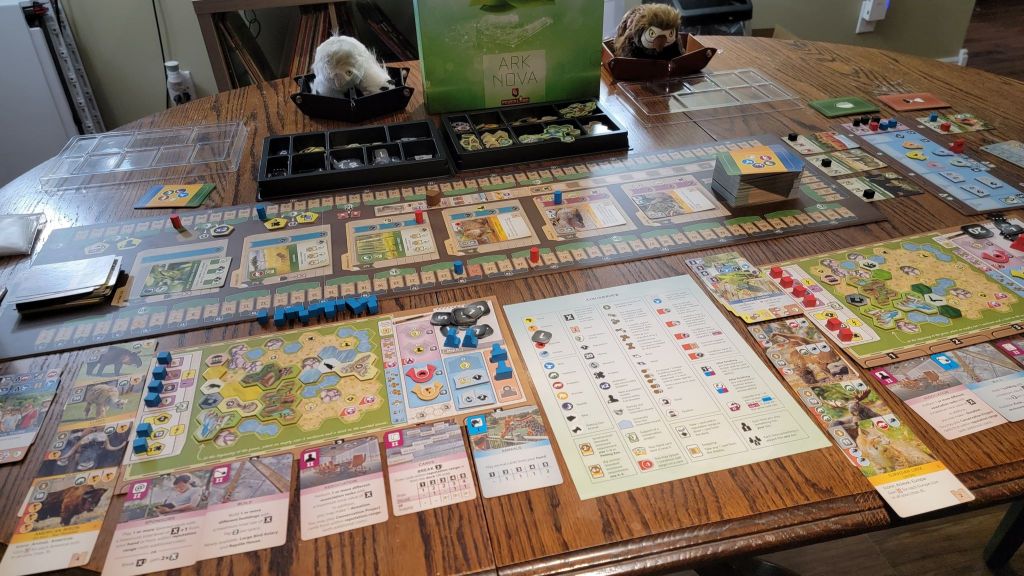
So to go back to the inevitable comparison to Terraforming Mars, I’ll say that while it scratches the same sort of itch, it is a completely different game. The action selection mechanism, combined with the lack of a common board makes turn structures feel very different. While there are a couple of “milestones” on the board to rush for, each player has their own board and the majority of goals can be pursued without direct competition from other players, making turn order and who goes first a lot less important then in Terraforming Mars and shifting the focus entirely onto each player’s own engine building. I do think fans of one will probably be fans of the other, but it’s also certainly worth owning both games.
At the end of the day I give Ark Nova a very hearty recommendation to just about everyone. People looking for a short sweet game or something without a lot of thinking will probably find Ark Nova too demanding, but anyone who enjoys strategy will find it excellent. A great and easily accessible theme, combined with mechanisms that still feel thematic make this a great way to introduce gamers to more thinky games, and those that already enjoy games at the complexity level of Terraforming Mars will find this an absolute treat.
Amanda’s Note: The cards need to be quite well shuffled the first run through, and you cannot be afraid of changing strategies. Just because you have set your cards up for a specific type of action/scoring mechanism doesn’t mean the cards will necessarily appear, and you may have to change your plans before it becomes too late. Overall, quite enjoyed it and look forward to playing it again now that we understand it better.
The Teal Deer
Designer: Mathias Wigge
Price: $80
Players: 1-4
2 player Scaling: Best with 2
Playtime: 30-60 minutes per player
Estimated Lifespan: In permanent collection
Estimated Average Play Frequency: Quarterly
Complexity: 4
Components: 3.5
Bang for Buck: 4
Value for Time: 5
Fun Factor: 5
Overall: 5
 Cardboard for 2
Leave a comment