
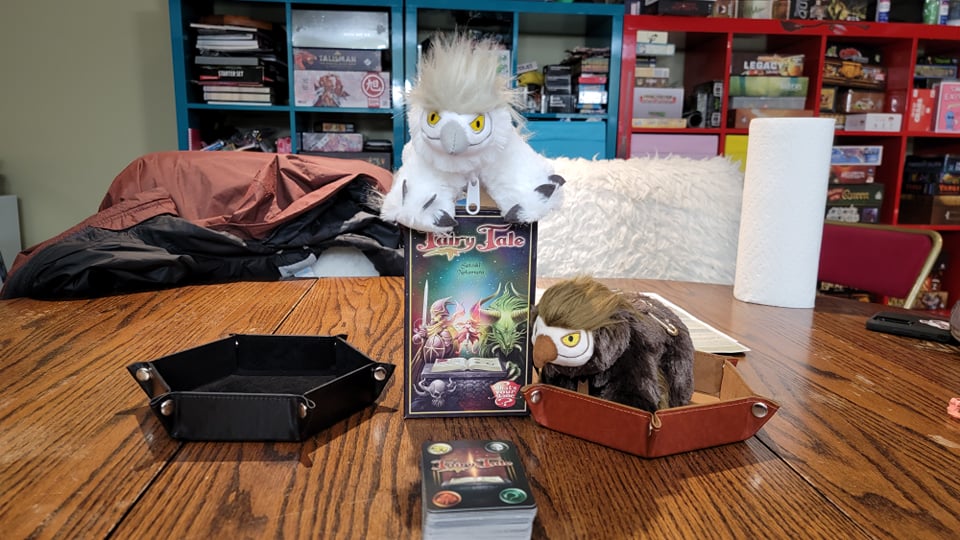
Greetings everyone. Amanda and I were recently joined by our ever faithful owlbear companions, Hector and Eddie, for a game of Fairy Tale. Fairy Tale is a drafting game, often compared to 7 wonders when it was released, although with it’s myriad expansions, they certainly aren’t similar anymore except in the they both involve drafting. But is the drafting fun? Read on to find out.
There is not much to say about the components because it is nothing but a set of cards and a fold out sheet with the instructions on it. The cards are of decent quality, nothing special but also nothing wrong with them either. I don’t much care for the graphic design, although I think it is a product of it’s time more than anything else. The art style for the card art is decent, but also seems washed out and blander than it needs to be. I can’t really put my finger on what the issue is,, but it seems like a much blander version of Yoshitaka Amano’s style of art. For those wondering who that is, he was the character art designer for many of the older final fantasy games. It’s not a total eyesore, but almost seems unfinished.
Fairy Tale is played over a series of rounds, during each of which the players will draft 5 cards each. Players then take turns simultaneously revealing the cards, 1 at a time, with each player revealing and potentially scoring, a total of 3 cards each round. At the end of the game, players score all their face up cards, most points wins.
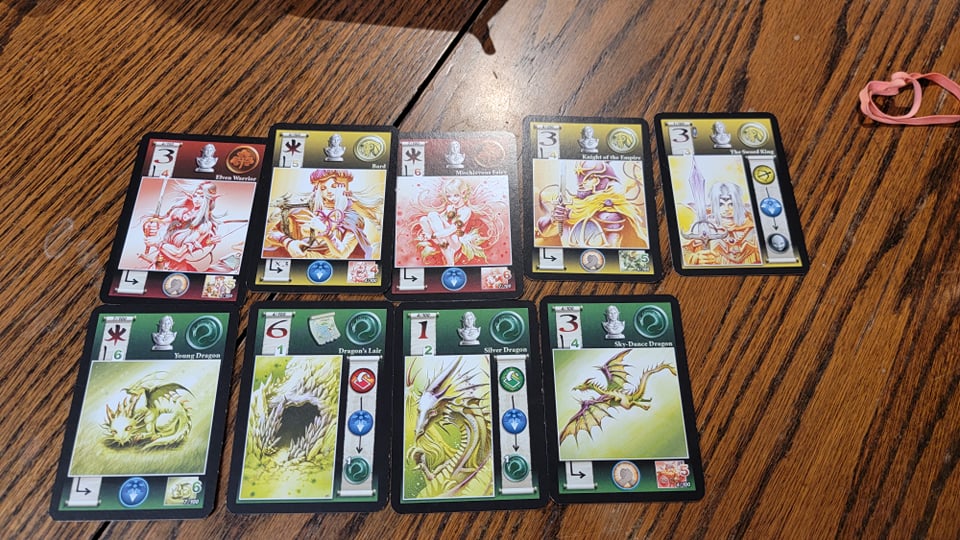
Although the gameplay is fairly simple, there is some nuance to how one drafts the cards because nearly all of them interact with each other in some way. Some cards combo with copies of themselves, some with specific other cards and some with certain types of cards, granting a scoring bonus. This will all be familiar to anyone who played 7 Wonders. What is unique to Fairy Tale is the ability to flip cards, making them unscorable. Flipping cards can be either an offensive move against other players with “hunting” cards, or a sacrifice for a greater score, for example the high point dragon’s den requires it’s player to flip a dragon card to place it down. Since other cards also have the ability to flip them back up, it makes for some interesting play as different players vie for different combos.
Overall I think Fairy Tale exists in a similar space as a base game 7 wonders, as a relatively light drafting game built on generating combos. This isn’t a bad place to be as 7 wonders is a fine game, but it’s also something of a weak point for Fairy Tale. If this were not such a small box game, it would likely be put up for sale or trade, however the fact that it is compact and easy to carry and store, as well as not bloated with excessive expansions, will guarantee it a spot on my shelf until one day when my small games shelf finally runs out of room.
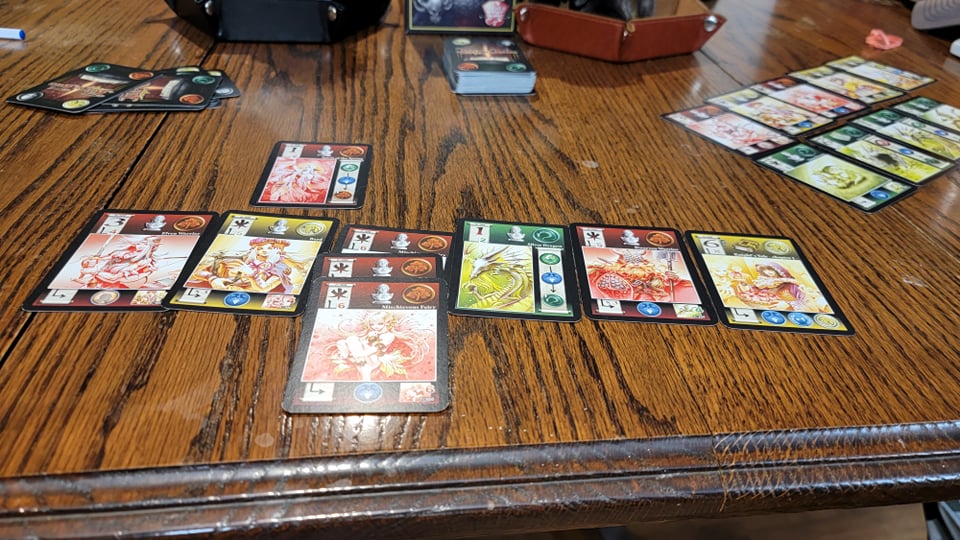
As far as the two player game goes, Fairy Tale suffers the same faults and enjoys the same plusses as any drafting game. Drafting becomes far more focused on denying your opponent combos, and there is much more potential for combo building yourself, not to mention that any “take that” elements become much more personal and spiteful feeling. How one feels about playing this two player will be about the same as one feels about playing any drafting game with 2 players, it works fine for me, but if you don’t like playing drafts with 2 players, this won’t change your opinion.
Fairy Tale is an interesting game in that while I find it decent enough to play, I can’t really recommend it. It’s out of print and doesn’t occupy a spot that can’t be filled with an easier to find game. 7 Wonders/Duel will do you just as well for a thinker draft, and Sushi Go/Party will do you just as well for a light, portable drafting experience. Unless you are just hardcore into drafting games, this one would be a pass for me.
Note: This game is pretty simple, but also quite fast. I don’t mind it, but we’ve owned it for several years and this was my first time ever playing it, and I’m not sure when I will (if I will) again.
The Teal Deer
Designer: Satoshi Nakamura
Price: Out of print, can be found on the secondary market for $20-$30
Players: 2-5
2 player Scaling: Decent, changes the playstyle a bit.
Playtime: 10 minutes per player
Estimated Lifespan: In collection, but only because it’s small
Estimated Average Play Frequency: Annually
Complexity: 2
Components: 4
Bang for Buck: 3
Value for Time: 4
Fun Factor: 3.5
Overall: 3
 Cardboard for 2
Leave a comment