
Greetings everyone! Today Amanda, Hector, Eddie and myself sat down for a game of Lizard Wizard, a kickstarter I have been anticipating for some time. I have heard it described online as a “Raccoon Tycoon 2.0” however I never played that game. I was originally drawn into the kickstarter by the art, but was convinced to order based on a gameplay video. How well does it stack up my our expectations? Read on to find out!
I’ll divide the components review into two separate sections, because I have the kickstarter deluxe edition and I’ll say right off the get go that it’s absolutely stellar, and almost entirely unnecessary. The resource tokens are some sort of hard plastic, the coins are metal and there are roll out neoprene playmats for all, as well as a very chonky first player token. Fantastic stuff all around, but not needed as the cardboard components are perfectly adequate and the playmats serve no purpose other than to organize your cards. Speaking of the cards, the art is some of the best I’ve seen in a board game. It’s the kind of art you’d expect to see on a classic fantasy novel, certainly a different style, but I would put it only one step shy of Boris Vallejo or Frank Frazetta. Excellent paintings that not only catch the eye and keep it throughout the game, but applied consistently. Artwork from Jacoby O’Connor & Annie Stegg will be enough to make me look at any kickstarter in the future for sure. I have a minor quibble with the metal coins, as the color choice, intricate design and similar size make it somewhat difficult to tell the 5s from the 10s, but the coins themselves are beautiful. The cards are especially excellent, being of excellent stock and size, and having fantastic art and outstanding graphic design. Lizard Wizard will surely catch the attention of anyone passing by the table.
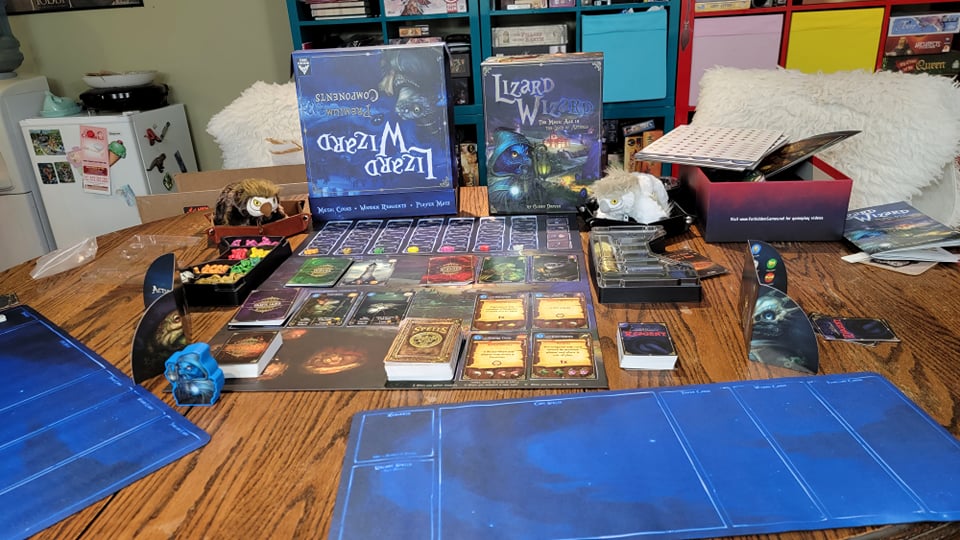
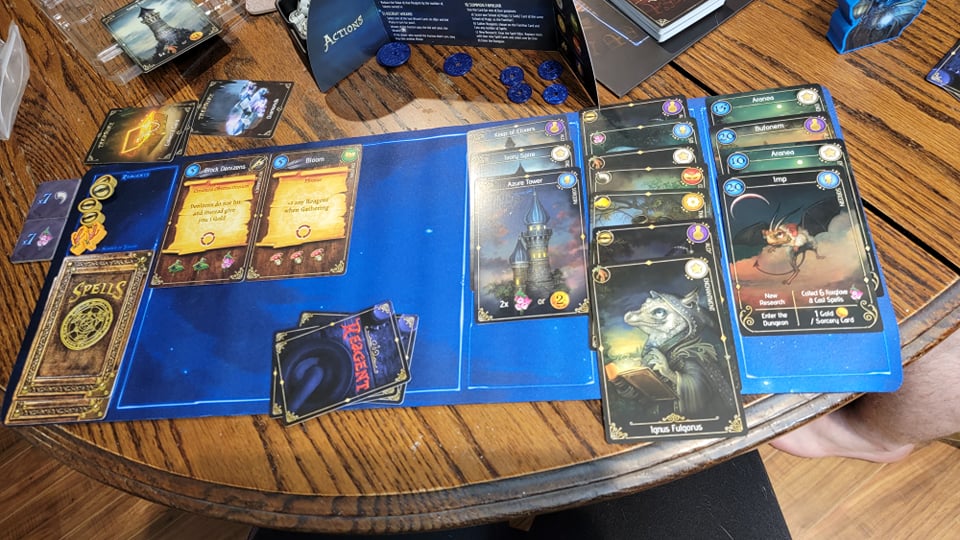
Lizard Wizard is at it’s heart a stock market and economic engine building game, which seems a little incongruous with the theming, but works pretty well overall. Players choose one of 6 different actions on a turn before play proceeds to the next player. Components gathering is done by playing cards, which also raises the value of a random set of resources, followed by the player being able to cast a spell if they have the required components. Players can also sell components for mana which is effectively the money of the game, devaluing whichever one they choose to sell. Wizards, which are part of the primary scoring mechanism as well as being able to improve a player’s gathering ability, are acquired via auction. Players who initiate an auction but fail to win get another action. Towers can be bought for either components or gold pieces, which are victory points otherwise, and are the other half of the main scoring mechanism. Spells can be bought and either kept for later or cast immediately if the player has components on hand. The final action is to purchase a familiar, which is generally the most expensive action, but comes with the most options. They can either score, provide a large amount of components, clear the spell shop and gain the player a free spell or allow a run in the dungeon, which is a very basic push your luck sort of thing. When one of the primary decks runs out, play continues to the end of the current round and the game enters final scoring.
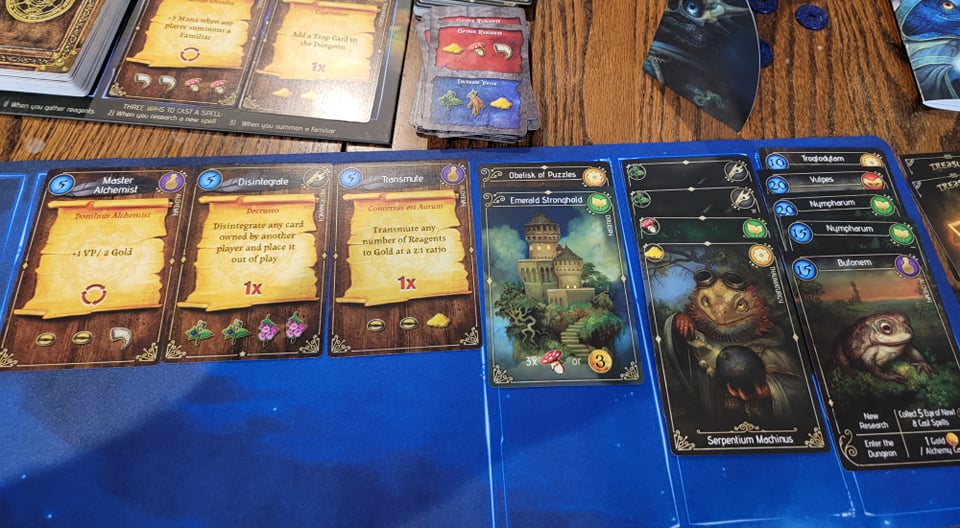
Lizard wizard is quite interesting in that eschews what seems to be the modern point salad approach of engine builders and instead gives the player a great deal of options but with a single goal; putting lizard wizards into towers, preferably ones which match their school of magic. There are a few other ways to pickup gold coins (which are worth a victory point each) from spells and dungeons, but this is largely chump change used as an alternative way to purchase towers. Even the achievements, which usually take several turns each to work towards, are only worth as much as a single wizard tower match. Even a non-matching wizard and tower set is worth more than all but the luckiest dungeon runs. This has a very interesting effect on the strategy of the game, as players will take alternate paths to a single goal, and since everyone’s towers and wizards are always on display it makes for fierce competition over certain wizards and towers, either for a large point scoring combo or to deny the combo for an opponent.
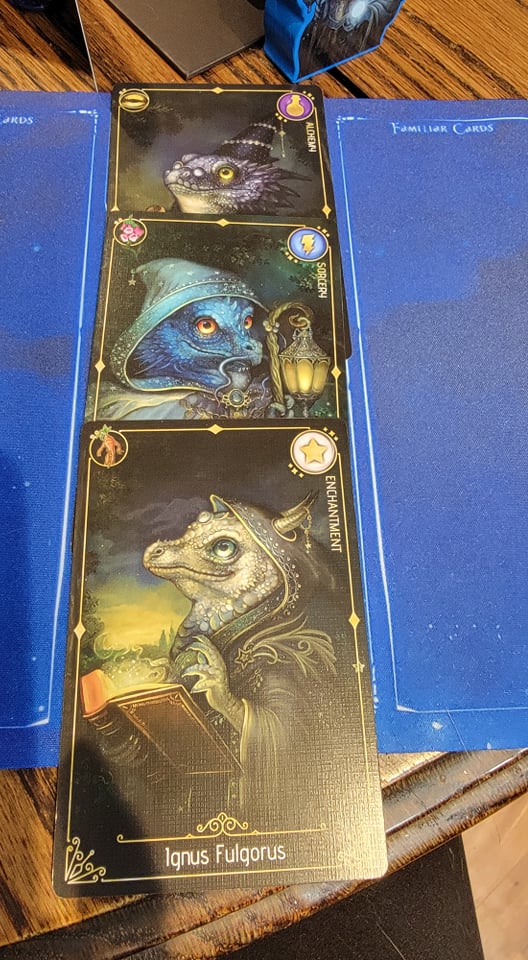
What I especially enjoy about Lizard Wizard is that I never felt stuck chasing down any specific resource. If the item I was trying to sell was at a low value, it was simple enough to try for something else, or buy a spell, or grab a familiar and do a dungeon run. While it is true that one should always keep a stock of mana to be prepared for a wizard’s duel, which is a mana based auction for one of the available wizards, there are many ways to acquire it and even more to spend it in furthering one’s goals. Particularly worthy of note are the spells. There are a great many of them and as far as I can tell, they are either all unique or have only 2 copies each. They provide different effects that either give a powerful one time bonus or ongoing bonuses that can help define your play style for a particular game. They are also worth bonus points at the end of the game if you have a wizard and tower pairing for their magical school.
The two player game is quite tense, and involves a great deal of figuring out what your opponent wants to do 2 or 3 turns down the line. You don’t want to pump up the price of mandrakes if your opponent is stockpiling them or is going to snag a bunch with a familiar, and keeping enough mana on hand to compete in bidding for wizards is more important when there are less of them. In a multiplayer game, there is far more volatility in the component “stock market” between turns and more cards will be cycled through the available options, so a player will need to focus more on their own strategy than trying to predict their opponent’s next move. Which style of play one is superior will be purely a matter of preference. One thing I do like is that the game adds an icon to all of the “take that” spell cards, so players can easily remove them if they prefer to focus on the economic parts of the game.
If it wasn’t evident from the review, I really like this game, and I would love to recommend it based on the art alone. I do have to say though, that outstanding artwork and production quality aside, this is still an economic engine builder. It’s certainly not Brass or Terraforming Mars, but it’s not light either, and if you aren’t keen on the idea of auctions, optimizing moves and manipulating and taking advantage of stock markets then I would probably give this one a pass.
Note: I just kept staring at the pictures of wizards and totally just chose which wizards I thought were cool looking at least twice in the game for purchase. One of my favourite parts of this game is that there are so many different things you can do to score and build up. You don’t HAVE to rely on only one strategy or thing, between the bonus points, wizards, towers, spells, and treasure hunting you can build up your points however you want. What I will say is that there is a ton of components gathering, but I would have rather they called them “components” than “reagants”. I love this game and look forward to playing it again! I did like the slight randomness of the spells, however, I am also looking forward to trying it without the spell deck. I recommend for anyone who likes: board games, lizards, and magic, not necessarily in that order.
The Teal Deer
Designer: Glenn Drover
Price: $60 for the retail edition
Players: 2-4
2 player Scaling: Adds more focus to counter other player’s moves
Playtime: 45ish Minutes per player
Estimated Lifespan: In permanent collection
Estimated Average Play Frequency: Quarterly
Complexity: 4
Components: 6 yes they break the scale.
Bang for Buck: 4
Value for Time: 4
Fun Factor: 5
Overall: 5
 Cardboard for 2
Leave a comment