
Good evening everyone, earlier today Amanda, Hector, Eddie and myself sat down for a round of one of my favorite euro games: Keyflower. Keyflower is part of the series of “Key” games and by far my favorite of the series and neither Amanda nor the owlbears had a chance to try it before. It also has several expansions, although we only played with the base set for this review. A mid-heavy euro, Keyflower is a combination of worker placement and bidding game, two of my favorite mechanics when they are well executed. How well does Keyflower execute them? Read on to find out.
The components of Keyflower are interesting in that on one hand, they are quite excellent and well produced, but on the other hand, cry out for a deluxe edition or pimping out. The resources and “keyples” (of which there are a great many) are excellent and well produced, but at the same, time, typical euro style bland. The tiles are solid, good looking and have an excellent graphic design style that makes it easy to tell what the tile is and what it does. The player screen are covered in gorgeous art, but are produced in an odd way that makes them difficult to assemble and break down. I do not understand why they wouldn’t have been printed with the same art on cardboard to make them easier to store, but that’s really my only complaint. Overall, excellent components, if a little bit bland in some places.
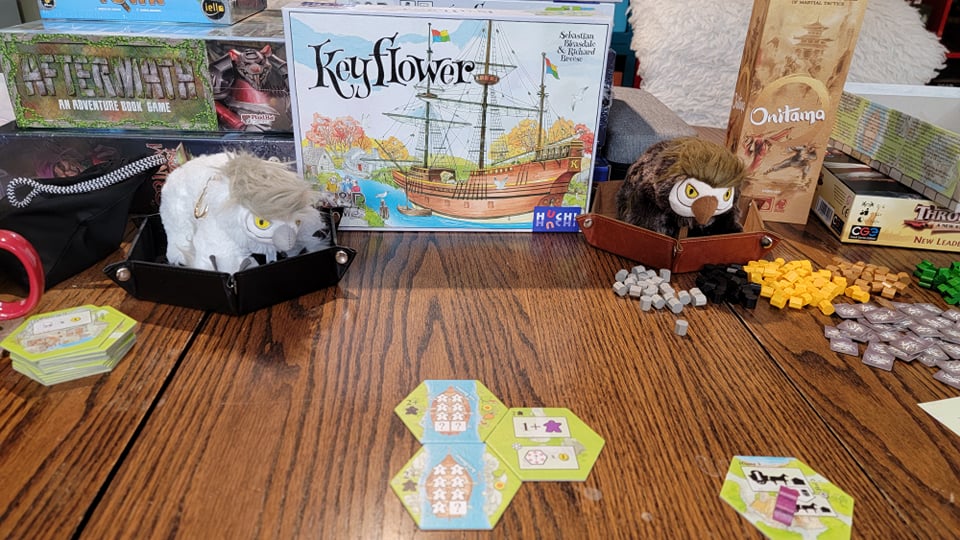
The object in Keyflower is to earn the most victory points by building the best village. In typical euro fashion, this is done by gaining resources, trading them for other resources or points, bidding on and upgrading tiles, placing meeples etc. Nothing special in a bare bones description of the mechanics, but what makes the game shine is how they all come together. Players will have a number of meeples to start a will get more each round from boats that arrive and are drafted in player order. Those meeples are used for both bidding on the tiles that become available each turn, or activating tiles to claim their effects. All players can use both their own and opponents tiles, as well as any available to bid upon, but meeples spent on other player’s tiles go to that player at the end of the round and the winning bid on unclaimed tiles also claims all the meeples on that space. There is also an escalation mechanic in using an already occupied space; another player may use an occupied space, but they must use more meeples of the same color that are already in on the tile. Play continues to the last round where no new meeples arrive and instead players choose from a selection of randomized end game scoring buildings to offer up for bid, as well as several bonus scoring boats. The player with the most VPs after four seasons, each representing a game turn, wins.
There are a fair number of moving parts in the game and so the summary above is very generalized, but it gives a basic idea of how the game is played. What makes the game stand out is the meeples, which form a sort of universal currency. There is a lot of decision making to do in terms of whether or not to use them to place for actions or to bid on tiles, the choice becomes particularly crucial when deciding whether or not to use them on an opponent’s space or a tile which you don’t expect to win the bids on, as those meeples will end up in the clutches of another player for the next turn. Each tile is also unique in it’s actions and how it upgrades, so there is a lot of player choice to be made, including whether or not to fill or bid on tiles you don’t need just for the sake of denying them to your opponent.

Keyflower also has some serious legs to it. Even before adding in expansions there is a multitude of unique tiles available for every season and only some of them will be used each game. Although this creates some challenge in strategy, I believe this to be a solid design choice. The game cannot be “solved” if the perfect wood based strategy can be thwarted by no wood scoring buildings becoming available or perhaps worse, only a single one becoming available and heavily bid on by the other players to deny it to the person who needs it. While some players may dislike the slight random factor, I quite enjoy it as it requires players to insert some tactical flexibility into their strategy.
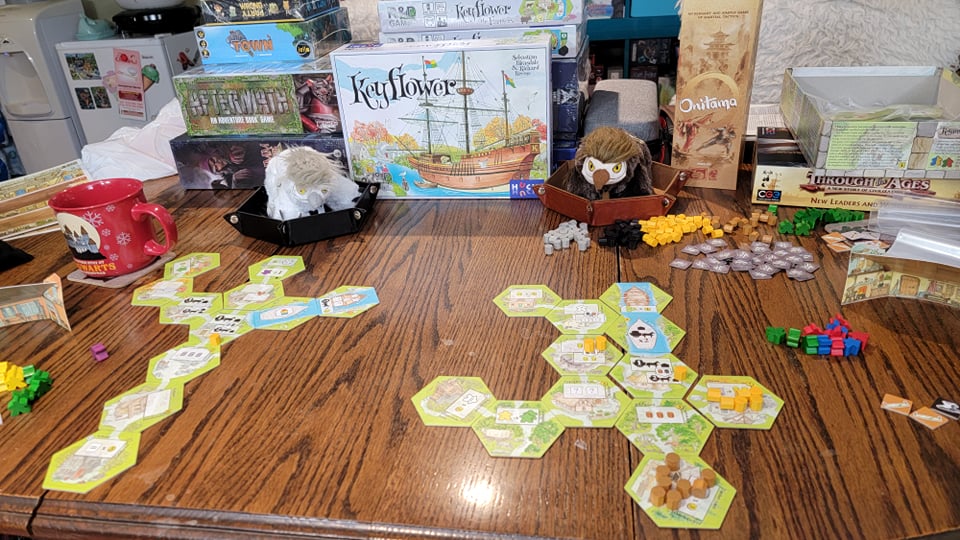
The two player game doesn’t change much about how the game is played, but makes the choices somewhat more meaningful. There are less tiles available to bid on at any given point, and less players means less opposing meeples to snag or entice. It does however lean out the playtime quite a bit, and although I have not looked at Keyflower as a 2 player game in the past, It may be my favorite way to play now.

I give Keyflower a very strong recommendation to anyone who enjoys thinky euros, especially those which involve worker placement or bidding, and to anyone who enjoys city or tableau building. As with most euros, stay way from this one if you need a great deal of theme or immersion in your games, it’s not themeless, but it is largely a mechanical exercise. Lastly this is not a friendly game to those new to the hobby, I would highly recommend being at least familiar with the basics of worker placement and bidding games before jumping into this one, it will be much more enjoyable if you are.
Note: The artwork is really pretty and I am looking forward to playing it with the expansions. It is really important WHERE you put your building.
The Teal Deer
Price: $55
Players: 2-6
2 player Scaling: Plays much quicker but with less options, a fair trade in my opinion.
Playtime: 60 – 180 minutes
Estimated Lifespan: Permmenant Collection
Estimated Average Play Frequency: Quarterly
Complexity: 4.5
Components: 4.5
Bang for Buck: 4
Value for Time: 4
Fun Factor: 4.5
Overall: 4.5
 Cardboard for 2
Leave a comment