
Good evening everyone and welcome back to the first review in our 2021 yuletide gaming event. Amanda and I were joined as usual by our faithful owlbears Hector and Eddie for a quick, but certainly not light, game of Onitama. Onitama is ostensibly a game about dueling martial arts schools, but is really a very abstract game that takes a lot from chess. It’s a quick game, lasting only 15-20 minutes per round, but certainly not a simple one. The real question though, is it any good? Read on to find out.
The components in Onitama could best be compared to a decent chess set, but more compact. The figures are decent, looking alike to a warrior monk but in a chess style, and are made from a solid resin of some sort. The board is a neoprene playmat, with simple but attractive art and the cards are of decent stock. It’s all wrapped up in an excellent box, which sits very pretty on a games shelf. That’s all the components so there isn’t a whole lot to say about them other than that they are solid all around.
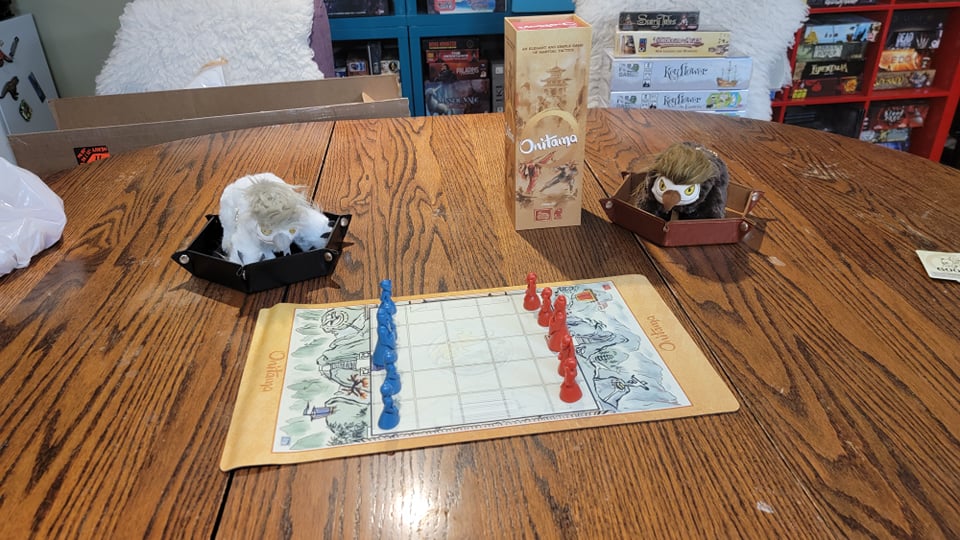
The object of Onitama is to either capture your opponent’s “master” figure or move your master into his starting space on the board. A very simple objective, but describing Ontiama that way is akin to describing chess as “just taking your opponent’s king.” Players get 2 cards each showing what moves their figures may make, with a third card in the middle of the board, which are drawn from a pool of 16 unique movement cards a the start of the game. The active player makes one of the moves corresponding to the card they have, then places that card in the middle of the board and replaces the one they used with the card from the middle. If their figure lands on another player’s figure, that figure is captured. Players take turns doing this until one of the victory conditions is met.
While the premise is very chess like, the limited number of figures per player, in addition to the fact there will be only 5 moves available for the whole game makes the strategy very different. Since any piece can make any move available to the player, one needs to think ahead in terms of movements and less in terms of pieces, especially since some of the cards give very oddball moves. Given that the moves will migrate between players, there is a definite balance that maintains the deterministic nature of a chess match, while adding a dynamic feel.
What Onitama does extremely well is condense the “feels” of a chess game down to 15ish minutes, although a game will certainly last longer if either player is prone to AP. Onitama delivers all the strategic thought of chess, with all the move planning and counter-play strategy of a chess game, and although I am tempted to say to not play Onitama with anyone you wouldn’t play chess with a half hour of AP is certainly preferable to 3 hours of it, so take that as you will.
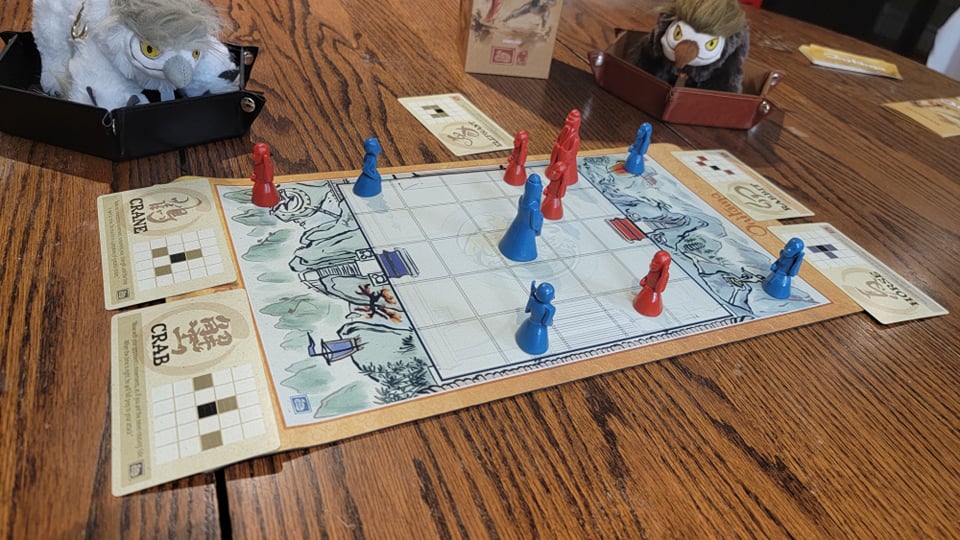
Overall I think Onitama will appeal to two types of gamers more than any other. The first being those who are interested in a chess like experience without all the stodgy memorization of opening moves and their appropriate counters. With the massive number of possible permutations of what card combinations will be used in each game, it’s not as “solvable” as the opening moves of chess, allowing players to actively strategize each game. Although it certainly rewards multiple plays, I would much rather play a game of Onitama with someone far above or below my skill level than a game of chess with someone far above or below my level.
The second group that this will appeal to is those looking to introduce new or very casual gamers into the hobby. Nearly everyone has played a game of chess or checkers in their life, 15 minutes to play something that’s a lot like chess is a much easier sell than 3 hours to go save the galaxy. I give Onitama a hearty recommendation to anyone who falls into the groups.
Note: I absolutely love this. I’ve wanted to play chess with Kage for a while, but it is a long and tedious game, as he stated, so we never quite broke it out. This gave that strategy experience but the added in the moment of having to pay close attention to both what you could do and what your partner could do with the limited movements available. The cards help you remember/know by showing exactly where you can move. I quite enjoyed it and think it’s a must have for anyone that enjoys strategy games but doesn’t necessarily have tons of time to play one on one with others.
The Teal Deer
Designer: Shimpei Sato
Price: $30
Players: 2
2 player Scaling: 2 player only game
Playtime: 15-25 minutes
Estimated Lifespan: Permanent Collection
Estimated Average Play Frequency: Monthly
Complexity: 5
Components: 4.5
Bang for Buck: 4
Value for Time: 5
Fun Factor: 4
Overall: 4.5
 Cardboard for 2
Leave a comment