
Hello and good evening everyone. Tonight I was joined by Hector, Eddie and Amanda for a round of Philosophia: Dare to be Wise. Dare to be wise is actually the first in a series of games, the second being; Philosophia: Floating World. I had backed the second one and in the pledge manager, the first was available for a very reasonable price (I believe 30 extra) and it looked decent so I decided to take a chance and add it in. I’m glad I did as it was an interesting experience overall. How Interesting? Read on to find out.
I was very impressed with the components right out of the box. The standout pieces are the player pawns, each are several inches tall representing the player’s philosopher of choice and are done in the style of marble Greek busts. They are gorgeous and very well produced, and although not necessary, do a great job of setting the mood for the game. The tokens and counters are all very solid, the art style decent and the graphic design well done overall. Other stand out components are the rule book, which I found to be both well written and pleasing to the eye, and the map, which is somewhat plain, but is printed separately on both sides for larger and smaller player counts. It could have just been markers on which spaces to use in the smaller game, but the double sided board is an excellent touch.
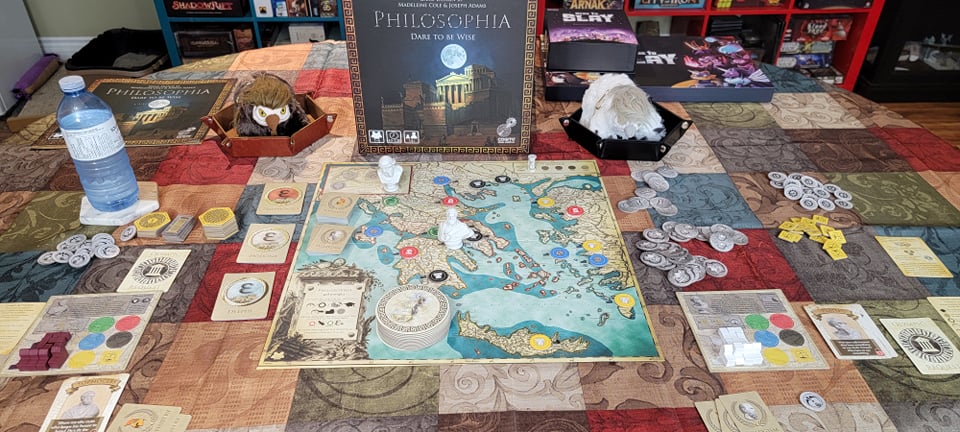
I would describe Dare to be Wise as it describes itself, which is to say it’s a sandbox, the theme of which is trying to become the greatest thinker of the classical Greek era. There are several mechanisms in their basic form all mashed up together, with the player having more or less freedom to choose which they wish to partake in on the path to victory. The goal is to have 3 labyrinth tokens at the end of the final age, and there are 6 main ways to get there, with one extra. 3 of these routes (winning debates, spreading followers and gaining wisdom) are effectively unlimited and remain open to players at all times, although other players can make things more difficult for them. The other 3 (building schools, claiming all of one type of location token and oracles) are limited and once the board starts filling up and certain cards and tokens are taken, they become are no longer able to be completed by other players, possibly with no one being able to complete them at all. The final option is an “Olympic Challenge” from one of the gods, which acts as something of a very difficult hidden backup way to get your tokens if it looks like you won’t be able to claim them via the normal path before game end. At the very end, all players with 3 labyrinth tokens engage in a final debate, the winner wins the game.
So the game gives you a whole lot to do, but is any of it actually fun? I would say that depends on how much you enjoy a hodge podge of various mechanics that works together surprisingly well. All of the various mechanics in the game are very shallow versions of themselves, but make for something of a deeper strategy game when mixed together and the only reason the game works at all is because they are fairly well balanced. The debates for example are more or less a paper scissors rock game between participants, using the sophistry and syllogism cards the players have collected. The oracles grant powerful cards that may completely change your play style, but they can only be visited once each per game. Spreading followers is as simple as dropping cubes at locations, but you have to drop a lot of them etc. So if you are looking for a deep dive into one particular type of mechanic, look elsewhere, but if you don’t mind your strategy to be playing around with various mechanics while making sure no player pulls too far ahead in any of them, then this is the right game for you.
Dare to be Wise will inevitably draw comparison to Western Legends, as the two are both thematic wide open sandbox games where you pretty much do what you want and the main interaction is just making sure the other players don’t run away with the game while you aren’t paying attention. I would say that Philosophia: Dare to be Wise is very comparable to the Western Legends base box; they both have a similarly large amount of things to do, and both convey their theme well through the actions you take in game. Which of the two you prefer would be very dependent on which theme you prefer. Once you start adding in expansions though, Western Legends has loads more options, whether this is a good or bad thing is largely a matter of preference.

As far as the two player game goes, it makes paying attention to your opponent more important. Despite it opening the board up, it actually gives you a little less freedom since both players have to adjust their strategies more frequently to avoid the single other player claiming some of the limited access labyrinth tokens. I think Dare to be Wise is probably best with 4-6 players, as turns are extremely quick and players will have a lot more freedom to play around with the various game options.
I was going to give this a very strong recommendation until I looked up the price for the TL:DR, and I was somewhat shocked to find that my kickstarter discount was massive, something like 70% off. I had expected the regular price to be the same as Western Legends, but its more like the same as Western Legends with several expansions. With that being said, it’s still a solid game, but you’ll have to be pretty in love with the theme to consider it as your sandbox game of choice.Note: I didn't actually feel like this game was comparable to Western Legends (which I love), but I very much enjoyed it. I think it would likely be a lot nicer with more people. Given the cost factor, unless you're really into philosophy, I'd go with Western Legends though.
The Teal Deer
Designer: Joseph N Adams, Madeleine Adams
Price: £80 ($135)
Players: 1-6
2 player Scaling: Playable, but not the best way to play.
Playtime: 60-120 Minutes
Estimated Lifespan: 3+ games
Estimated Average Play Frequency: Bi-annually
Complexity: 3.5
Components: 5
Bang for Buck: 1.5 (5 at the kickstarter discount)
Value for Time: 4
Fun Factor: 3.5
Overall: 4

 Cardboard for 2
Leave a comment