
Good evening everyone. I apologize for the long delay, but between the world opening back up and a course I’ve been working on, there has been little time for board game reviews. Hector, Eddie, Amanda and I have played several new games in that period, and over the next day or three, we’ll try and get review for all of them posted. With that being said, the topic of the night is Sushi Roll. If you’ve played Sushi Go, then you can skip this review and assume your opinions of both games are the same, because it’s literally the exact same game with dice rolling. Haven’t played Sushi Go or just curious about my opinion? Read on.
The components for Sushi Roll are on par with Gameweight’s usual fare; simple but well produced bits with appeal for the family and mass market. The custom dice are hefty and durable, the cardboard bits are colorful but simply designed and easy to read. The rule book is simple but very easy to understand, not only because it is a simple game but also because it’s well laid out and written. The graphic design and art style match the family weight nature of this game well, overall it is a treat for the eyes and hands.
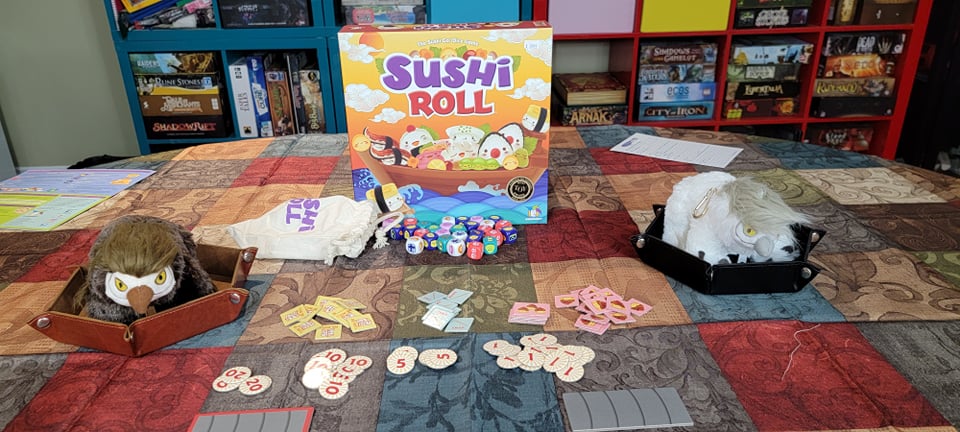
As far as gameplay goes, it’s a very simple dice rolling and drafting game. At the start of a round, everyone rolls their dice. The player with the red conveyor uses any tokens they wish, then keeps one of the dice they rolled in their sushi tray. Players continue around the table doing the same until everyone has had a turn, then pass their conveyor to the next player and play repeats till there are no dice left. Players score and a new round begins and after 3 rounds, the player with the biggest score is the winner.
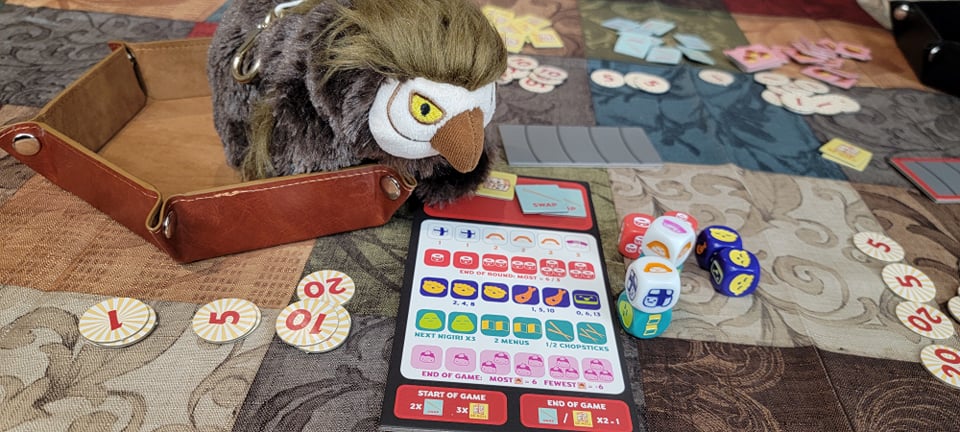
As far as scoring dice go, the dice have almost identical scoring mechanisms to their counterparts in Sushi Go. some are worth straight points, some score more in combination, some you want the most of at the end of the round or the game, some increase the score of other dice etc. Chopsticks let you swap a die and the only real new mechanic is the menu token which grants a reroll of as many of your dice as you like. It can be clutch if you are trying to score a big combination near the end of the round or game. The scoring dice vaguely correspond thematically to their faces, but it’s a very light game, so it’s not like immersion is a big deal.
As I said near the top, your opinion of this game will be identical to Sushi Go, unless you either really like cards or really like dice. The complexity level is exactly the same, the sort of family-weight game that is more meant to get a social group gathered around the table for an activity rather than any sort of mental challenge. With that being said, it’s one of the best things it can be for what it is. The colorful and attractive components will be enjoyed by younger and adult gamers alike and it’s the perfect sort of game to play with your friends who don’t understand how you can possibly have 100+ board games on a shelf in your rec room, or as a filler for your more gamerish friends.
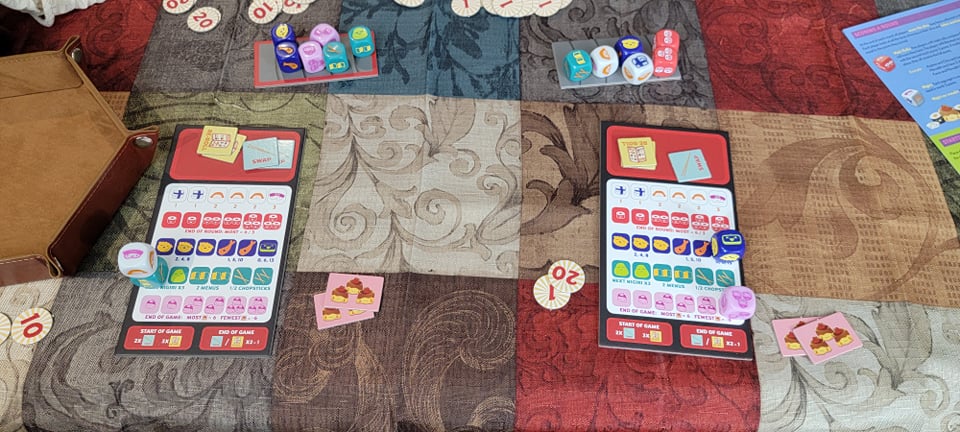
The two player game actually gets a little more tactical in how it’s played. Because you can see all of the dice you will be receiving each round, and you can reasonably guess what your opponent will draft after their first pick or two, the choice of dice becomes a little more complex, especially if you want to deny them access to a dice that can complete a big scoring combo. The chopsticks and menu tokens also become more valuable. Overall though it brings the complexity from a 2 to a 2.5 on a scale of 10, still not complicated.
Overall I would highly recommend this to anyone looking for a filler type game, or for something to play with younger gamers or non gamer friends. Unless you have a large collection, I think it would be very difficult to justify owning both this and Sushi Go, which one you want will be entirely up to whether your playgroup prefers cards or dice.Note: I prefer Sushi Go Party. This is cool and novel and maybe would be a bit more interesting with more people, but at the same time, you really don't know what you're going to get since the dice are constantly rerolling. If you like Yatzee and Sushi, here's a game for you!
The Teal Deer
Designer: Phil Walker-Harding
Price: $20
Players: 2-5
2 player Scaling: More tactical
Playtime: 15-20 minutes
Estimated Lifespan: Added to collection
Average Play Frequency: At every social event non-gamers are invited to.
Complexity: 1
Components: 5
Bang for Buck: 5
Value for Time: 5
Fun Factor: 4.5
Overall: 5
 Cardboard for 2
Leave a comment