
Good evening everyone, although it was not today that we played, Amanda, Hector, Eddie and myself recently sat down for a game Paladins of the West Kingdom. Paladins is a game in Shem Phillip’s excellent “X of the (cardinal direction)Y” series, where Y = the West Kingdom. I originally picked this one up entirely based on how much we enjoyed Architects of the West Kingdom and Raiders of the North Sea, and have since ordered Viscounts, as well as the West Kingdom Tomesaga, but I am getting a little ahead of myself here.
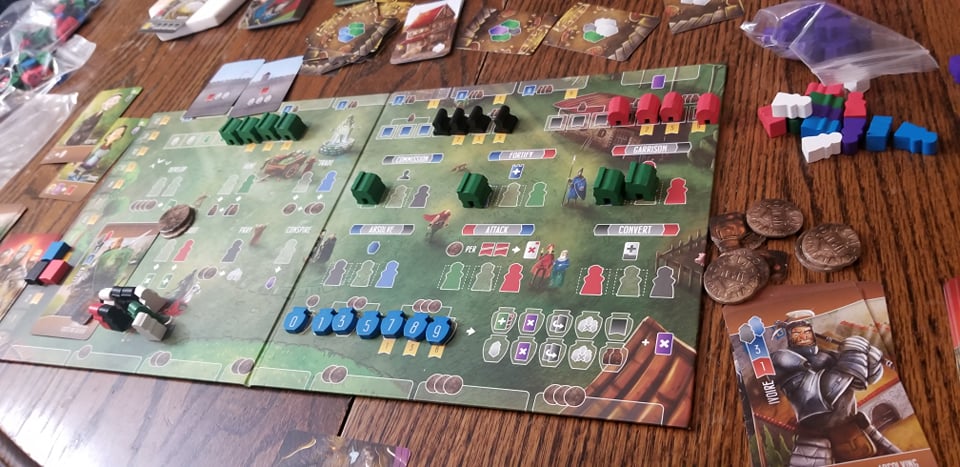
The components are pretty standard fare for this series of games. Quirky, caricature-eqsue art for the characters with a excellent board art and good graphic design. As usual the symbology on the cards is simple and clear, with rulebook consultations rarely needed, but an excellent glossary provided for each of the cards that has an ability. The custom wooden meeples are good and for the most part, but some of the design on them could use improvement. A few of them are “arch” shaped and I’ve found that even after less than a half dozen paythroughs, these tend to break or snap. It’s a minor design oversight, but an annoying one none the less.
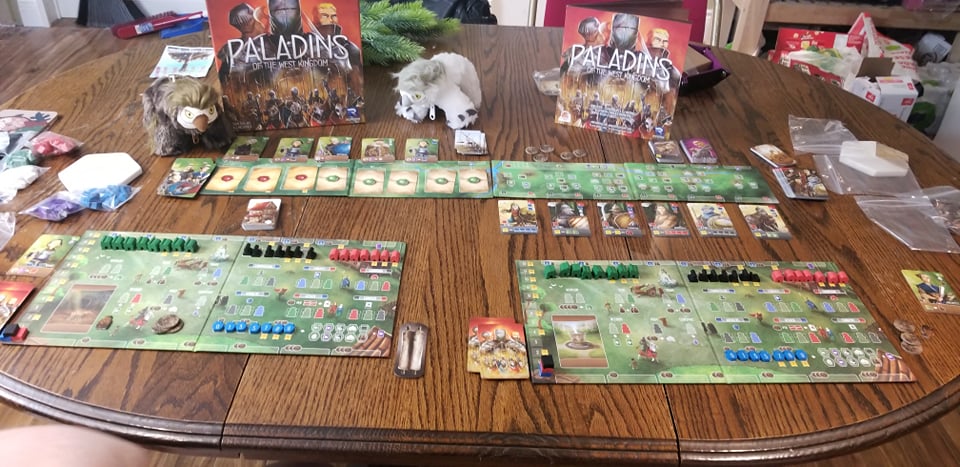
The game overview will be even less deep than normal, as this game has a lot of moving parts, and insofar as I can tell, is the most complex game in the series. I would describe it as something like a cross between Scythe and Orleans, in that you are both taking actions and engine building at the same time, with nearly everything you do affecting the map or your board, gaining resources and building your engine all at the same time. The gameplay is less about focusing on which type of individual action you will do each turn and more about managing where your overall focus is as most actions generate an effect on all aspects of the game.
Each round of Paladins starts with players drawing 3 paladins from their deck, selecting one to use this round, one to go on top of your deck and one to go to the bottom. The active paladin grants a stat boost for the turn and a special ability, as well as several workers. Players then select a card from the tavern that grants additional workers, which along with up to 3 holdovers from the last round, form your pool of workers with which to perform actions. Much like in Orleans, these workers are are placed on corresponding spots on the each players board to activate an action, some of which mimic actions in Orleans 1 to 1.
Where the game draws similarities to Scythe is that nearly every action apart from straight resource gathering raises one of your primary statistics and grants a bonus, which gets better each time the action is performed, and the bonus is revealed by removing the meeple on top of it. Choosing your paladin wisely each turn makes actions easier (or possible if your stats are otherwise too low), and assists in gathering resources. There are also multiple versions of each action, for example you can recruit a villager for a permanent bonus, or send them on a quest for a 1 time reward. Ditto for invaders who can be converted for an end game scoring bonus or defeated for an instant reward. Monks and strongholds can be placed out in various areas of the map to gain resources and bonuses, but each requires a different stat to be able to claim a space. You can upgrade your fortifications on your board for bonuses and well as absolving sins to remove corruption. Every single action I just described also increases one of your primary stats by at least 1, and has a minimum requirement in a different stat and resource cost, and the majority of them provide an escalating bonus as they are performed.

I won’t get into the gameplay any further I mentioned that is a very simple overview of the game but it should suffice to give you a basic idea of what the game is about and drive home the main point; this is a complex game with many moving parts which all interact, and credit goes to Shem Phillips for managing to balance it all out. One of the things I enjoy is that the game is structed so that you cannot simply specialize in one area and hope for the cards to come up to match your strategy, even if you focus on strength you are going to need to spend a little time working on your faith and influence and likewise with the other stats. Skillful choice of the paladins each turn will allow you to maximize your resource gathering and shoring up areas you are weak in so that you can focus on a main strategy to execute. This game has both tactical and strategic elements and the escalating capabilities of each player as the rounds progress make it a very enjoyable arc overall.
As far as two player play goes, the game seems fairly balanced for it. Many of the map spaces are only available in a 3 or 4 player game, although by the look of it the 4 player game would be a little tighter in terms of spaces available. Most of the action actually takes place on the player boards themselves, and interaction between players is limited to snagging cards or board spaces that another player had their eye on. I don’t suspect the game will play significantly differently with a higher player count, apart from play length.
Overall, I give Paladins a very strong recommendation for gamers who like more complex games that reward multiple playthroughs. It’s certainly not for the faint of heart, there is significant setup time and it’s not a short play, especially your first game though, but if you enjoy engine building and making a bunch of tactical options work together to form an overall strategy, then this is the game for you.
Note: It is possible to do everything right and just not get the resources/abilities to win depending on card pulls etc. What you might start out with as a strategy may have to evolve during gameplay. That being said, it’s a decent long game, but I personally prefer Architects.
The Teal Deer
Designer: Shem Phillips, S J Macdonald
Price: $60
Players: 1-4
2 player Scaling: Changes little but the play time
Playtime: 60 minutes + 15-30 minutes per player
Estimated Lifespan: 10+ games
Average Play Frequency: Bi-annually
Complexity: 5
Components: 3.5 (loses 1 for the frequent broken meeples)
Bang for Buck: 4
Value for Time: 3.5
Fun Factor: 4.5
Overall: 4.5
 Cardboard for 2
Leave a comment