
Welcome back everyone! Amanda and I are joined today by Hector and our new owlbear Eddie for a game of the big book of madness, which for a game published by Iello, is surprisingly complex and deep. While it can be said that any board game is basically an exercise in probability management wrapped in a theme, The Big Book of Madness exemplifies this more so than just about any other. But is it a fun game? Read onwards to find out.
Although this game steps outside of Iello’s standard style, the components do not and are up to their usual excellent standards, with colorful and sharp artwork. This game has many cards, in fact I think it uses every standard size of card from poker to square to mini-euro and tarot and they all have a place where they fit nicely into the insert. The cards themselves are good quality as well, easily shuffleable and hold up well to repeated play. I have a minor quibble in their choosing to make the player decks, which are the ones shuffled the most, often out of the smallest cards, but the cards are of great quality so I will not complain too much.
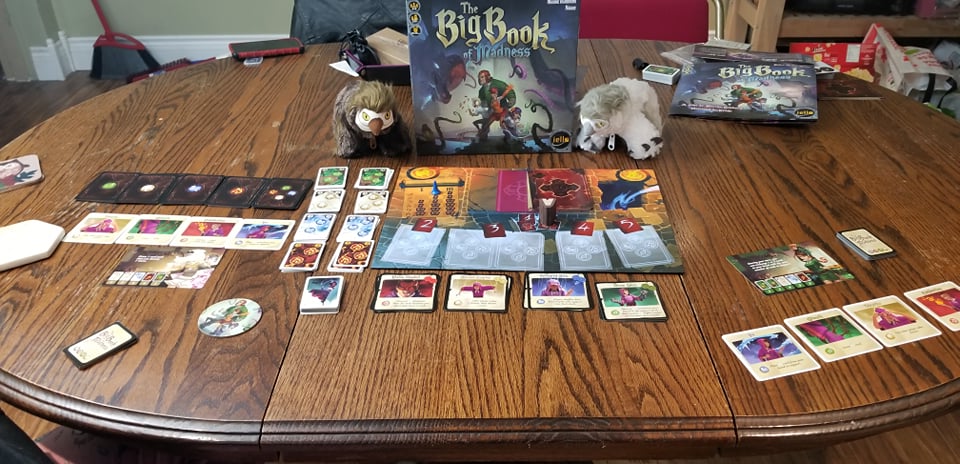
The game itself is a little bit of a paradox, as on one hand it is an extremely mechanical co-op game, far more so than the art style would suggest, but on the other it is wrapped up so well in it’s theme that it feels much lighter than it actually is. The thematic goal of the game is to defeat the monsters from the titular Big Book of Madness that the player’s group of young wizards unwittingly released into the wizard school. This is done through an extremely mechanical process of breaking curses and casting spells to perform actions and deckbuilding, and when I say that every action counts here, I really mean it. The spells, despite just being mechanical actions are thematically very well done, between the excellent art and clever matching of theme to mechanics, it feels a lot less mechanical than it plays.
In terms of how the game plays, I don’t know if I’ve ever played a co-operative game where the action economy is so tight before. Players get a starting deck of mana which they will build as the game goes on, as well as a selection of starting spells, which are the actions of the game. The monster of the round will arrive, do something bad and drop curses on the board, which must be dealt with or more bad things will occur. Players get 5 turns to break the curses before the end of the round during which time they may also deckbuild. If they succeed they get a bonus and the monster is defeated, otherwise the monster strikes again before the next one comes out. This repeats for 6 rounds, if the players defeat the final monster they win, if they do not, or succumb to madness along the way, they lose.
As you may have guessed from the tone of the review, The Big Book of Madness is something of a mixed bag for me, a little like the paradox of the game’s nature. I enjoy the theme, the art and the mechanics of the game as a whole and certainly have no problem playing it, but one has to be in a certain mood. One of the game’s strength is it’s replayability, many parts are randomized and you will only see a fraction of the spells, monsters and the like each time you play, but I am nearly certain this creates unwinnable combinations and the difficulty of the game swings wildly based on which combinations of spells and monsters turn up in any given playthrough. The Big Book of Madness is a brain burner that demands optimal play from it’s players, as taking a single wrong action in turn 3 of round 1 can cost you the game in round 4. Skillful only gets you in the door, even with optimal play you may find there was no winning strategy. I wouldn’t call it hard, as I certainly have a higher winning playthrough percentage in this game than many other cooperative games, but I will call it extremely unforgiving and not entirely fair.

In terms of scalability I think you would need to be madder than the book to play with more than 2 players. Firstly because of the action economy of the game players only get 5 turns per round, meaning that with more than 2 players, there will be less than 2 actions per player per round. The second is that because each move is so important, there tends to be a strategic discussion before each action, and I can’t imagine trying to co-ordinate that between 3 or 4 players, it’s not an easy thing to sort out even being married to the 2nd player.
All in all I give The Big Book of Madness a very cautious recommendation. It’s certainly not the type of game you just want to pick up and play. It requires the right type of player, in the right mood, with the right group or partner. On the other hand, if you want a mechanically deep co-operative puzzle that feels far more theme and much better art than the usual games of that type, this is probably the game for you.
Note: I absolutely love this game, which is why I chose to play it on my birthday. That being said, I do believe who you play with makes the difference here entirely, as Kage said. I like the strategy behind the actions, however, there are times when the deck is not on your side and there is nothing you can do.
The Teal Deer
Game: The Big Book of Madness
Designer: Maxime Rambourg
Price: $35
Players: 2-5
2 player Scaling: I wouldn’t play any other way
Playtime: 60 – 90 minutes
Estimated Lifespan: In permeant collection
Expected Average Play Frequency: Quarterly
Complexity: 5
Components: 5
Bang for Buck: 5
Value for Time: 4
Fun Factor: 4
Overall: 4

 Cardboard for 2
Leave a comment