
Welcome back everyone. This evening Amanda, Hector and myself decided to play a around of Dune: Imperium. This was one of the most anticipated games of 2020, and although we’ve had our copy for quite some time, we were planning to save it until we could have a full compliment of 4 players. Unfortunately our province has been largely locked down due to COVID and we were both a little bored, so we decided to play with 2 players.
I will begin with the components as usual, which in this case are solid all around, but extremely bland. I understand a deluxe kit is coming down the pipeline at some point, and I will likely end up purchasing it as I have never been a fan of just pushing cubes around, especially in a game which otherwise captures the theme of it’s source material quite well. The various cubes and meeples are of great quality though. The artwork is overall excellent, both for the graphic design, card art and especially the iconography. There are a bunch of different icons in this game, and I don’t recall having to look them up once after the initial rulebook readthough. The rulebook is also decent.
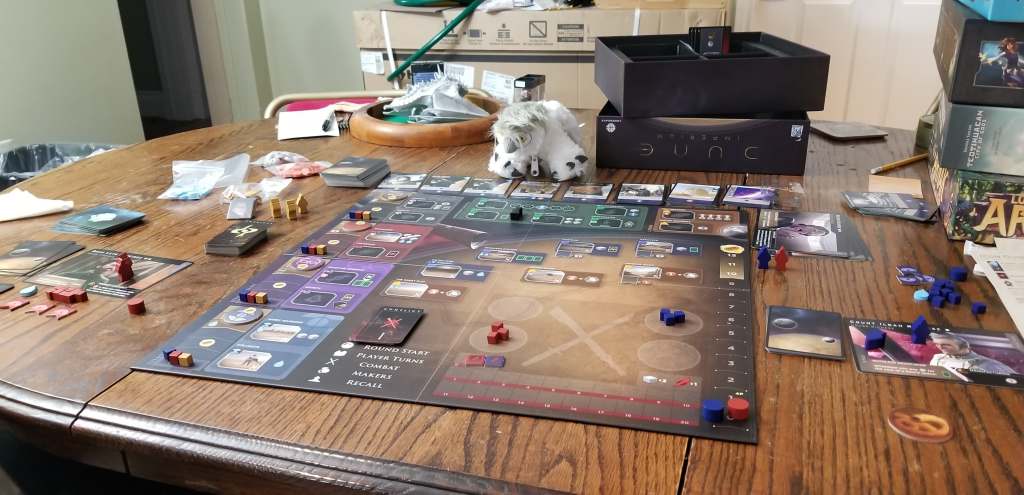
As far as the gameplay goes, Dune: Imperium is going to inevitably draw comparison to Lost Ruins of Arnak, as they were both highly anticipated deckbuilders with worker placement released in 2020. So to get it out of the way; they are completely different beasts, despite sharing mechanisms. Lost Ruins of Arnak is more like a classic worker placement that just happens to involve deckbuilding, the only real player interaction is blocking potential spaces for other players to move into, where Dune: Imperium is pretty in your face about several aspects, as well as having a battle every turn.
There are almost 3 different games integrated into Dune: Imperium and although it makes for a somewhat lengthy rulebook read, they mesh well and it’s almost a requirement to capture the theme. The deckbuilding part of the game is the engine which drives the rest. Cards can be played during your turn in order to place your agents (workers), or reserved till the end of your turn where you do a reveal, in which case they offer influence to buy new cards, bonuses in combat or miscellaneous bonuses, all of which are completely different to the actions on the card when it is played during the turn.
The second part of the game is the worker placement, which is driven entirely by cards from the deckbuilding aspect. Here players will place their agents on a space to gather resources like money, spice (which must flow) and water, as well as building and deploying troops and gaining influence with various factions from the books, which is one of the primary ways to gain victory points. Players can also gain intrigue cards, which are quite varied and can effect the game in different ways.
The third part of the game is the conflict at the end of every turn, after every player has “revealed”. It’s actually quite simple but each round has significant bonuses often including victory points, so there is going to fierce competition between players. Each player tallies up their forces they have deployed, plays cards to influence the result, and then gets a prize based on how well they did. It’s by far the simplest part of the game but building up to it over the other parts of a player’s turn is important because of the powerful rewards. After this, if one player has 10 or more points or the conflict deck is empty, final scores are calculated and the player with the most points wins, otherwise on to the next turn.
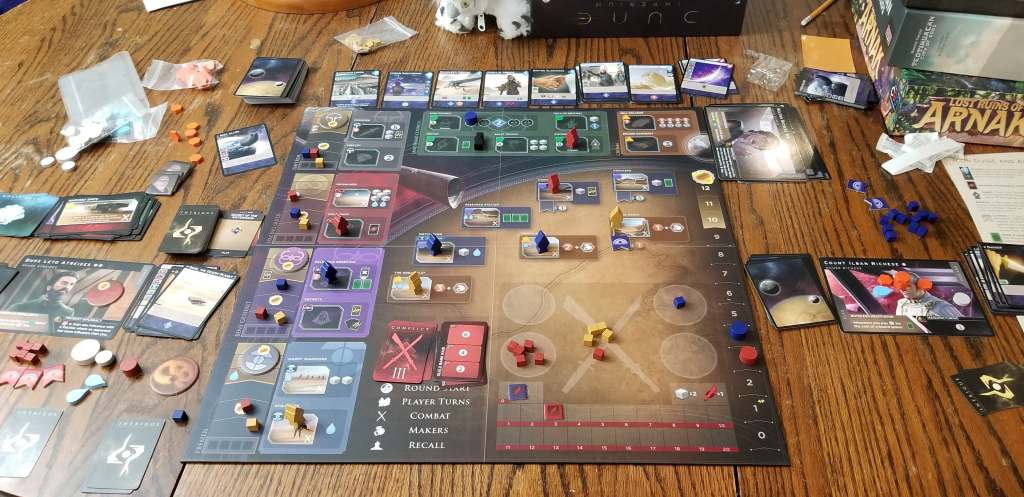
Overall I am not a fan of pointlessly combining mechanisms in games, but the integration here is seamless and incredibly effective. The cards drive the worker placement, which drives the resource gathering and troop building and deployment, which in turn decides who wins the battle, which often gives resources to fuel the next turn and so on. It also captures the feeling of the novels very well, the conflict is not confined to any one front, but rather mercantile, political and martial battles are fought in intertwining ways. Each system is also represented by very solid gameplay mechanisms to back it up, and I was very impressed with how they came together.
This game also looks like it has some serious legs as not only are there many different options and paths to victory, but the conflict deck is randomized and different to each game, and the imperium deck, from which players draw their cards, is quite sizeable and different cards will come up each time. I expect this one will be enjoyed well into the future.
Dune: Imperium’s biggest fault lies in its two player mode, which was somewhat disappointing. The card driven automa is to put it bluntly, an asshole. It doesn’t gain points but will place out workers to block you, try to steal your alliances and join (and potentially win) the fight, where it gains nothing, but denies players their rewards. The problem is it’s entirely random, often gaining massive amounts of combat power at random or occupying spaces that usually require several turns of resource building to be able to use. Because there are always a much larger number of spaces available than players will fill, randomly filling some of them tends to just punk one player’s plans without making the board any tighter. There could have just been a d6 roll or some other random chance to make certain spaces unavailable each turn (put a sandworm on them or something) and it would have been a better solution without making the game feel actively hostile to players.
Despite the issues I have with the 2 player mode, I would definitely recommend this game to fans of worker placement, even if they are not familiar with the source material. Fans of Dune on the other hand are in for a serious treat.

Hector adds that this game is quite delicious.
Note: I agree with everything said, especially that the extra “player” in 2 player is a giant jerk! There are multiple ways to win and try to get the points, and no one special way to play. I look forward to playing this with three or four players in the future.
Game: Dune: Imperium
Designer: Paul Dennen
Price: $65
Players: 1-4
2 player Scaling: Not so great
Playtime: 30ish minutes per player
Estimated Lifespan: Definitely going in permenant collection
Expected Average Play Frequency: Quarterly
Complexity: 4
Components: 4
Bang for Buck: 5
Value for Time: 5
Fun Factor: 5
Overall: 5

 Cardboard for 2
Leave a comment