
Good evening everyone. Today we bring you the first official entry into our “First Look” series, wherein we shall review a long campaign or legacy game within our first 3 playthroughs to give our first impressions, with the intention of following it up with another review once we either complete the campaign or get sick of playing it. Technically we began this with our “Gloomhaven – Jaws of the Lion” review, but we didn’t have a name for it then, so here we are.
So I’ll start out by saying that Sleeping Gods is the first kickstarter I’ve truly been excited about since the Conan board game’s original release. I am a huge fan of Ryan Laukat’s work in general and I think he may is most multi-talented designer whose games I’ve played, creating both great mechanics and wonderful stylish artwork and stories for his games. I have played most of his work, and have yet to play a game of his that was not at least decent. So how does Sleeping Gods hold up to that legacy? Read on to find out.
Beginning as usual with the components, I’ll start by saying that the kickstarter edition which I played is, as typical of kickstarter editions, overproduced to hell and back and unfortunately I have not seen the retail version to know if it holds up. The box is gorgeous, and the tokens, of which there are many, are excellent. The resource tokens are especially nice, but again, kickstarter version. The 10 or so different decks of cards are all nice, with an excellent finish. There is really nothing in the box that is not well designed and produced, often to the level of unnecessary overproduction. I will say that if the retail version is even half as good, then you’re getting your money’s worth. It even contains what appears to be Esoteric Order of Gamers rules summary right in the box, big plus.
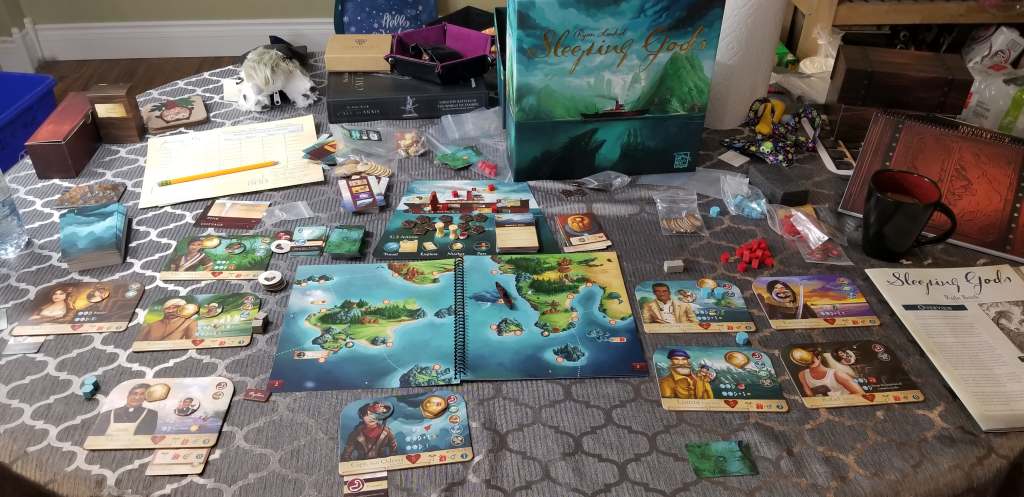
Some cracks in the veneer start to show however, when you get to the quickstart guide and unpacking the box. There is a lot of setup to do, which is fine, and not uncommon in a campaign game, however they seem to go out of their way to make it unreasonably difficult to get started. The quick start guide begins with a little vignette of the story, and introduces some game basics and combat. Unfortunately it leaves key parts out of both, so not only does it not actually teach you how to play the game, it teaches you how to play wrong, leaving out several key parts of each section of gameplay it purports to teach and omitting several major parts of the game entirely. It also lists some components by name and some by picture, leaving out images of some of the components you need for no particular reason. I highly recommend reading the rulebook first, it’s not that complicated, and then playing the intro thingy in the quickstart. The quickstart guide also tells you to incorrectly search for some particular “adventure” cards when you are actually looking for “market” cards, which wouldn’t be a problem but for the fact that searching through the adventure deck when not instructed can have a minor spoiler effect.
Speaking of spoilers, there will be a minor one in the following paragraph, so stop here and skip to the next one if you don’t want to read it. The game is filled with Laukat’s now signature world building driven by short vignettes, much like and presumably inspired by the old choose your own adventure and fighting fantasy books. Although the writing never reaches that level of depth since most players want to play the game and not read it, it suffers from some of the pitfalls of that medium, namely punishing the players for making a bad choice with no context on how to make the correct one. For example at one point you must choose to either fight invaders in a village or put out several buildings they had set on fire. There is no context saying which is a greater immediate threat and, wanting to save the lives of those inside, Amanda and I put the fire out with the intention to fight the invaders afterwards. Turns out they were a bunch of empty, unused buildings and there was no one or anything valuable inside and we were supposed to fight the invaders, as the villagers drove them off but one was wounded in the process. There is absolutely no context given to suggest one outcome is more useful than the other. There are also a disturbing number of times where your get a choice that boils down to going right or left, with no way to differentiate between the two, and one path is basically “You walk down a hall and hurt yourself and get tired, go back and go the other way”. This is sloppy game design and lazy writing if done sparingly, but it seems to happen with every third choice you make. Spoilers end here.
With all that being said, Sleeping Gods is not without it’s strong points. The writing is as usual in Red Raven gams, snappy and excellent at making you feel like a part of the world you are gaming in, and the art is outstanding. From the cards to the maps and everything in between is some of Laukat’s best work, and I generally enjoy his style to begin with. The mechanics, although they feel like 2 or even 3 different games mashed together, are all decent, though the ship management part of the game does not seem to mesh all that well, and probably could have used some streamlining. The game save system is pretty decent. Although I find 7th continent to have many better systems as far as adventure games go, the save setup in Sleeping Gods is definitely superior to 7th’s.
All in all my first impressions of Sleeping Gods is that it is a competent, yet disappointing game. There was a lot of hype around the art and the fact that this would be a story based campaign game, but a game cannot run on style alone. Where the dressing and sides of Sleeping Gods may be some of the best around, the meat of the game does not satisfy, especially when compared to both other adventure style games and Laukat’s own previous work. There is probably a lot less “story” in Near & Far for example, but the game that drives the story is much better. Sleeping Gods smacks of not having had enough time to streamline the game and properly integrate it’s systems and attempts to make up for this by wrapping it all in a gorgeous package. Were this the first game of it’s type, and games like Near & Far or 7th Continent not in existence, I would say that it was a noble first attempt at something new, but it’s from a veteran designer in world where this sort of game has been done before, and so I remain, thus far, unimpressed.
Note: The “quick start” severely turned me off from wanting to play the game. It forces you to go through several moves, but “assume” that it ends how they’ve written it. If I wanted to watch a tutorial of how to play, I’d have done so before opening the box. As Kage mentioned above, read the rule book or you’ll be confused, irate, and disappointed.
All in all, it did seem fun once we started the adventure properly, but as previously stated, there were many times where you had to make a haphazard guess and hope there weren’t severe consequences. Perhaps that’s how life in the jungle searching for idols would go, but I’d like to think that especially for people that are somewhat physical and attentive, we wouldn’t just go full steam into things– there’s no way to self preserve unless you basically don’t play.
The Teal Deer
Game: Sleeping Gods
Designer: Ryan Laukat
Price: $80
Players: 1-4
2 player Scaling: Worked well for us
Playtime: Theoretically Infinite (It’s a campaign played as one long game with saves)
Estimated Lifespan: 1 Campaign, possibly 1 more with Expansion
Expected Average Play Frequency: Weekly until finished, then not for some time
Complexity: 4
Components: 5
Bang for Buck: 5
Value for Time: 3
Fun Factor: 3
Overall: 3
 Cardboard for 2
Leave a comment