
Good evening everyone! By the time you’re reading this it is probably already 2021, but on the off chance it is not, I hope you have a very happy new year. For our first new year’s eve game Amanda, Hector and myself decided on a little co-operative deck building action with Shadowrift.
Shadowrift was one of the first games I kickstarted. At the time of it’s second edition being crowdfunded, Amanda and I were playing a lot of Thunderstone and enjoying it quite a bit so the idea of a co-operative deckbuilder was very attractive to both of us. There really wasn’t anything like it at the time. Although apparently the first edition was lacking a great deal, including a board, I never played it, so I cannot compare it to earlier releases.
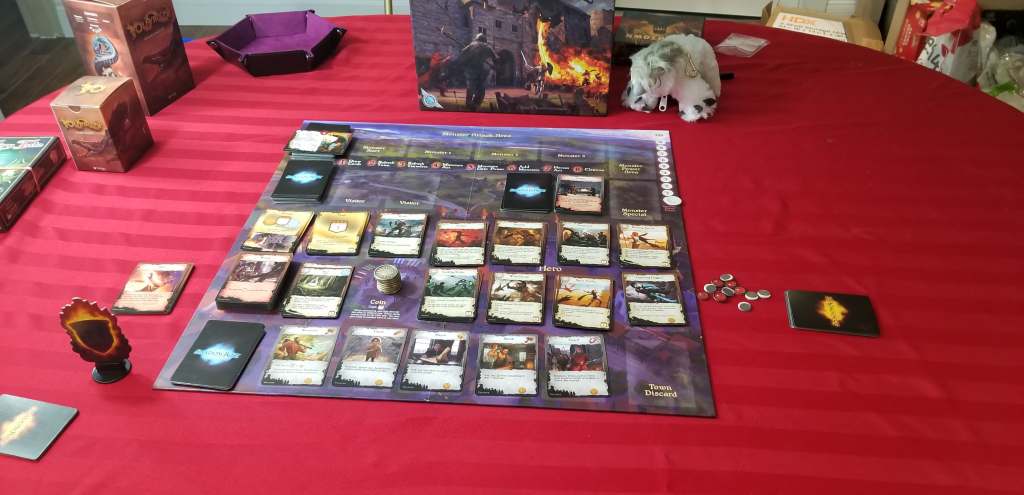
Setup for a game of Shadowrift can be done at random, like many deckbuilders, or from a set of pre-made scenarios included with the base game; and added to with each expansions. Regardless of method, each player gets a default starting deck, and there is an enemy faction deck, 8 cards for players to purchase as well as certain default cards available for every game. Players win by either sealing a number of shadowrifts equal to the number of players, or by building all the walls to fortify the town from attack.
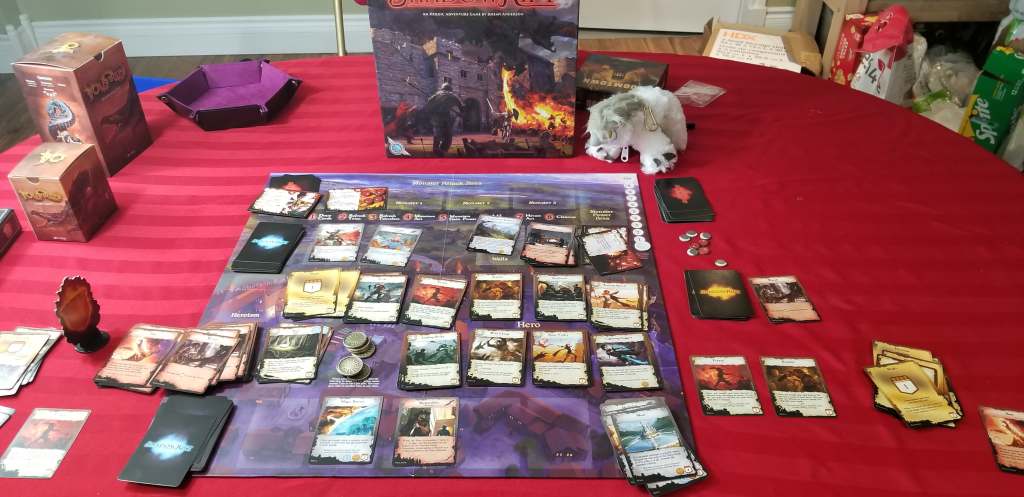
The gameplay is fairly unremarkable deck builder gameplay for the most part, with players trying to defeat enemies before they kill the townsfolk or smash walls. The main thing that sets Shadowrift apart from other deckbuilders is the town system. There is a row of 5 town cards drawn every turn, which represent the denizens of the town. These can be characters who provide aid to the players, traitors who harm them, or walls. This is also the players “life meter” as players lose if the town row is ever filled with corpses from dead townsfolk and/or traitors. A visitor deck allows players to replenish or add new townsfolk, as well as a chance for traitors to sneak into the ranks.
I will say that I certainly like this game less than when I originally purchased it. Don’t get me wrong, if you want a co-op deckbuilding game, it’s not a bad choice, but it feels very generic, and the genre has innovated quite a bit since it was released. The deckbuilding is fun, but doesn’t feel much different from any other deckbuilder, and although the game has had several expansions released, they all start to feel kinda samey after a while. I also feel that the game sometimes outstays it’s welcome on the table, you often know whether you are going to win or lose well before either event actually happens, and a swing of bad luck and shuffling can knock you out of the game 90 minutes in, even if you’re otherwise doing very well.

That being said, Its a pretty decent production overall. The mechanisms are quite solid, and both the instruction manual and the game board to a great job of explaining the turn structure. It’s also a fairly easy game to get into, and would make a great introduction to co-op games to a player who likes deckbuilders, or an introduction to deckbuilders for someone who already likes co-op. The production value is also pretty solid, the cards are a nice stock, and the artwork, although somewhat limited, is decent all around.
In the end I will give Shadowrift a soft recommendation. The whole thing feels a little bit dated, it’s a lot like playing Dominion now compared to when it came out, it’s still a fine game, but it just feels like the deckbuilding world has moved on. There are better deck builders out there, and there are better co-op games out there, but as a bridge between the two, you’d be hard pressed to do better.
Note: I cannot believe Kage would post such horrible lies about this game. I think this game is amazing and I love it. It’s definitely one of my favourite deckbuilders and I love how all of the different components come together between the townsfolk/visitors and the strategy of getting enough cards to hit, as well as buying other useful things, like visitors or walls. While the artwork might seem a bit grim, it is called SHADOWrift, after all.
Maybe we had played this too much in previous years for Kage to keep liking it, but I still absolutely love it, and personally don’t find it outdated at all. It is, as he said for all intents and purposes, a cooperative version of Thunderstone. Since Thunderstone was the second “real” board game I ever played (first was Arkham Horror) I assume this will always have a special place in my heart, no matter how many more games we have in the future.
The Teal Deer
Game: Shadowrift
Designer: Jeremy Anderson
Price: $65 for the base game $22 per expansion
Players: 1-6 (Do not play with 6)
2 player Scaling: Decent, but slows the pace of the game significantly
Playtime: 60-120 Minutes
Estimated Lifespan: Played out pending expansion content
Average Play Frequency: Quarterly
Complexity: 2.5
Components: 4
Bang for Buck: 4.5
Value for Time: 2
Fun Factor: 3.5
Overall: 3.5
 Cardboard for 2
Leave a comment