
This afternoon Amanda, Hector and I sat down for a game of the Marvel Champions LCG. Marvel Champions is one of the most recent entries into Fantasy Flight’s series of “Living Card Games” in which you purchase a base set of the game, then expansion packs. Unlike collectible card games, where packs contain random cards of various rarity, in the LCG format, each expansion contains the entirety of the set often with duplicates, making akin to a mini expansion for a traditional board game.
Marvel Champions has an excellent aesthetic and overall great components. Every part of this game is taken directly from, or is an homage to, comic books. From the illustrations to the graphic design to the card art to the rulebook to the fonts, there is absolutely no mistaking what this game is about. The components themselves are simple but good, high quality cards, life counters and tokens for damage and the like. My biggest complaint is the box, which contains spaces for the many dividers you will need, but no dividers. I had assumed these would be released with each expansion, but no, if you want them you will need to make them yourself from foamcore or something similar. With the amount of LCGs under Fantasy Flight’s belt, and the obvious space for them in the box, the decision not to include them is staggeringly stupid, but it was made.

The game itself is more of an overall system than a hard set of rules, as both the heroes you choose and the villains and scenarios you choose to play against will drastically change the nature of the game. The basics of the game are a bit of a mash-up of the Arkham Horror LCG and the Lord of the Ring LCG, the influence of each can be seen in this game. Players take a turn, playing powers, attacking the villain, thwarting schemes, summoning allies and the like, and on the villains turn, the villain either attacks the players or advances their scheme and deals out an encounter to each player, which may be additional attacks, summoning minions or enhancements or general detriments to the player. This process repeats until either the heroes or villain wins.
Although this sounds simple, one of the greatest things Marvel Champions does is make each villain and hero feel quite unique. By providing a solid but somewhat loose system to play within (The “golden” rule in the book is “If the text on a card contradicts the text in the book, the card takes precedence”), each of the encounters and schemes plays quite differently. Amanda and I had not played in quite some time so we did a relatively straightforward game by facing Rhino which is basically a straight up brawl. However there is always a sub scheme of some sort going on, so each game can play differently even with the same villain. Some villains can’t be attacked at all and must be thwarted, others are teams, and many of them manipulate the basic rules of the game in some way to their advantage, and various other twists. The same is true of heroes, each of which plays quite differently, and can often drastically change how the game is played depending on their cards, they also each bring along their own nemesis and schemes which may show up during gameplay, which really drives home the theme.
The challenge factor in this game is significant if you don’t do manual deckbuilding. It seems the default decks are quite decent well balanced against the game, and you can do some basic deckbuilding without having to actually manually sort through the cards. Each player chooses an archetype such as “aggression” or “justice” for their hero at the start of the game and gets a set of cards to match it. So you can change your play style by by playing an “aggressive” Thor (the default) or a “justice” Thor. This gives the game a fair bit of legs on it’s own, but you can also get deep into deckbuilding as the game allows you to customize a deck out of up to 50 cards, choosing any cards you want as long as they either belong to your hero, your archetype or the neutral types. I have not played with this too much but I suspect it will make the game considerably less challenging if you take the time to do it, and may even be required for some of the more difficult villains.
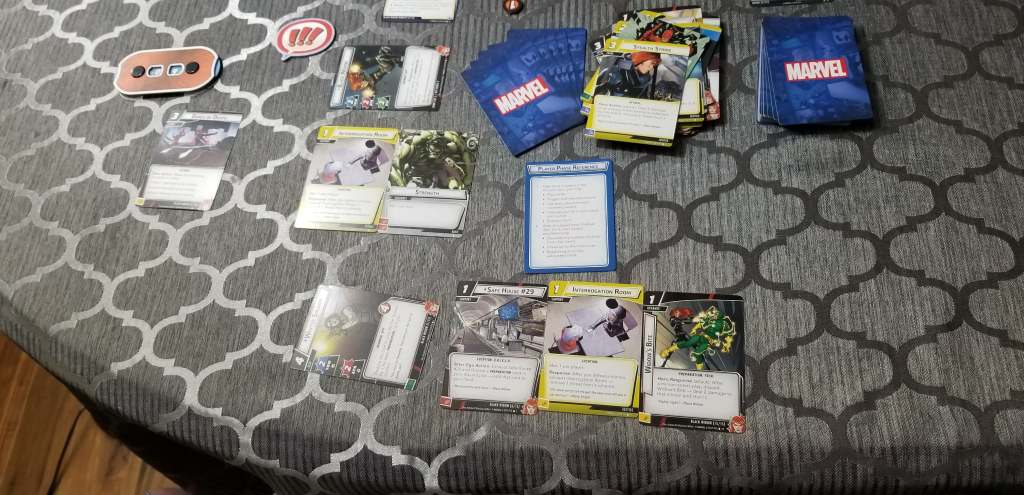
The scalability is a little wonky in this game, as unlike many games of this type, I believe it actually gets easier with more players. For all of the villains I’ve seen so far, adding players effectively just gives the villain an extra turn for each player, but since players are working together, playing with a larger group doesn’t really make the villain any harder than with a single player, but allows you to take a specialized group instead of a more balanced approach. Amanda and I played Thor and Black Widow as an example and it was easier for her to control the schemes while I beat down the opposition with Mjolnir than I think it would have been to try to manage half as much of each with Thor alone.
Overall if you like co-op games and you like heroes, this is an excellent game. It’s simple to learn but has a very versatile system, allowing it to capture the feel of a great comic book arc or superhero movie. My only reservation is that it is not cheap to collect a complete set, though it’s also not necessary unless you are a completionist.
Note: I have previously played with She Hulk in the base set and found it no less fun. The great thing about these characters is that everyone has a different specialty but their moves and tactics stem entirely from what their actual character would do. Since Black Widow (Natasha Romanov) was trained as a spy, a lot of her technique is based on doing things in advance so that when the opportunity arises you can then spring things on the enemy. I quite enjoy this game and would recommend it.
The Teal Dear
Game: Marvel Champions: The Card Game
Designer: Michael Boggs, Nate French, Caleb Grace
Price: $65 for the base game, $20 per hero or villain, $45 per campaign expansion
Players: 2-4
2 player Scaling: Excellent, my favorite place to play.
Playtime: 30-60 minutes
Estimated Lifespan: Till they stop making superhero movies, then 50 more years
Average Play Frequency: Usually only a couple times a year, but in batches of several games
Complexity: 3.5
Components: 4
Bang for Buck: 3
Value for Time: 4
Fun Factor: 4
Overall: 4

 Cardboard for 2
Leave a comment