
Welcome back! For our second game today, we continue our journey into the wizarding world with Harry Potter: House Cup Competition. Having not been terribly impressed with Death Eaters Rising, we decided another Harry Potter game would be in order. House Cup Competition is a game that has interested me for some time as regular readers will have noticed that Amanda and I like worker placement a great deal.
The components for this game are all around pretty decent, but not particularly special. The tokens are good cardboard and the cards are decent (although annoyingly, most of ours arrived with a slight bowing, a sign of too tight packaging). The one thing that stands out are the little alchemical test tube things used to store your gems for scoring at the end of the game. The stand for the tubes is well designed and the tubes themselves are nice, I just wonder if it was necessary to spend so much on a component that does nothing but track your score. Regardless it looks nice, and no other parts of the game descend into overproduction.

House Cup Competition plays like a fairly typical worker placement game, so much so that the theme seems a little pasted on to the game. This is not necessarily a bad thing, as the developers obviously wanted to focus on making the game good and may have had developed the game entirely separate from the theme and just added on Harry Potter upon acquiring the license. On the other hand, while the cards mention events from the books and movies, there is no imagery apart from iconography. Your characters could just as easily be samurai training in weapons skills and completing battles and duels in ancient Japan and the game mechanics, entirely unchanged but for the names of things, would work exactly as well as it does in the wizarding world.
Players get three students from their house, each starting with zero skills, and are able to place them on the board to either improve their skills, gather resources such as magic and knowledge or collect lessons and challenges to be completed. A player can complete a lesson, if they are able, either before or after placing their students. After the placement phase, players gain their students back and have the opportunity to complete challenges using the skills and resources they have built. As the game continues more locations, randomized for each game and hidden until revealed, become available. They generally are better than the default spaces but require higher amounts of skill or resources to make use of.
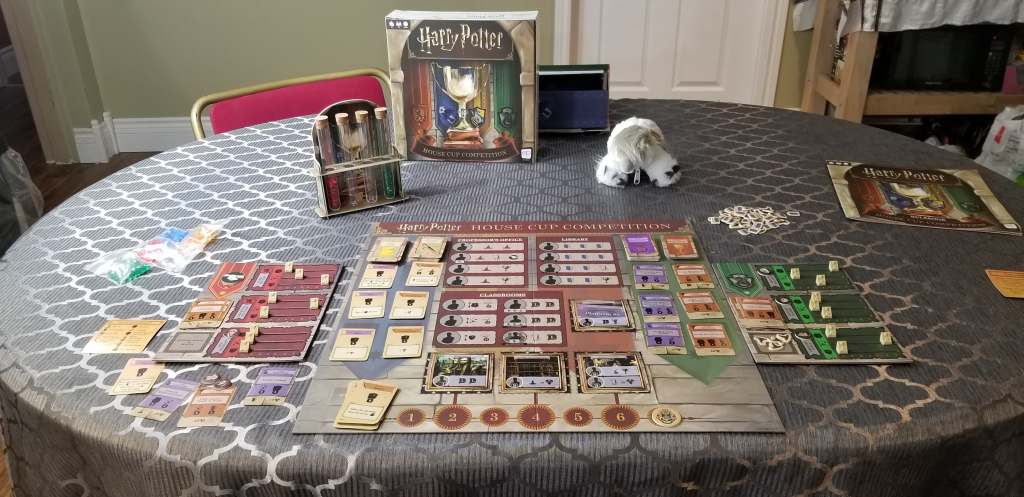
The worker placement is very tight, especially in the two player game where there are no duplicate spaces, and very limited amounts of similar ones. With only three workers to place each turn it makes every placement critical to make the most out of your lessons and complete challenges. This is the kind of worker placement where one spot being stolen by your opponent can ruin your day, but since you can easily do the same to them it levels out. It looks like the first round or two before locations open will be even tighter in a 4 player game, which unlocks only 1-2 additional spaces per player, who each bring an additional 3 workers with them.
Overall I highly recommend this to fans of worker placement, even if you are not a fan of the wizarding world. The mechanics are very solid and the board is tight, making for a good, tense and competitive worker placement game, which you can always pretend is about samurai if you really hate the theme.
Note: This game was much more fun than Death Eaters Rising, but, it’s really a matter of luck and take that of who goes first. In the end we were very close, and while I did enjoy it (especially because the gems in test tubes are very pretty) I would say that Harry Potter Hogwarts Battle is a much more fun and well themed game. As Kage said, this is a worker placement game that is enjoyable and works, but doesn’t necessarily need to be Harry Potter themed, and might very well have not been developed with a particular theme at all.
The Teal Dear
Game: Harry Potter: House Cup Competition
Designer: Nate Heiss, Kami Mandell
Price: $48
Players: 2-4
2 player Scaling: Excellent
Playtime: About 30 minutes per player
Estimated Lifespan: 10+ games
Average Play Frequency: Quarterly
Complexity: 3.5
Components: 4.5
Bang for Buck: 4.5
Value for Time: 5
Fun Factor: 5
Overall: 4.5
 Cardboard for 2
Leave a comment