
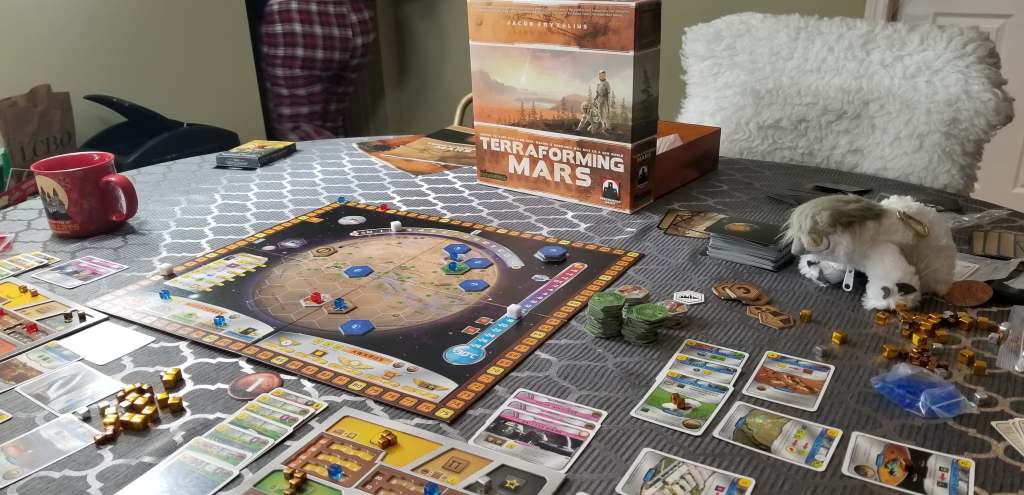
This evening Amanda and I brought Hector along for a journey into one of my personal favorite games and perennial favorite of the engine building genre; Terraforming Mars. I was initially very unimpressed with Terraforming Mars, when I first played I found the components to be bland and the theme dry, but subsequent playthroughs with a group more inclined to the genre showed that the game is not only great fun, but one of my all time favorites. For today’s game, we played with only the prelude expansion, which I generally refuse to play without.
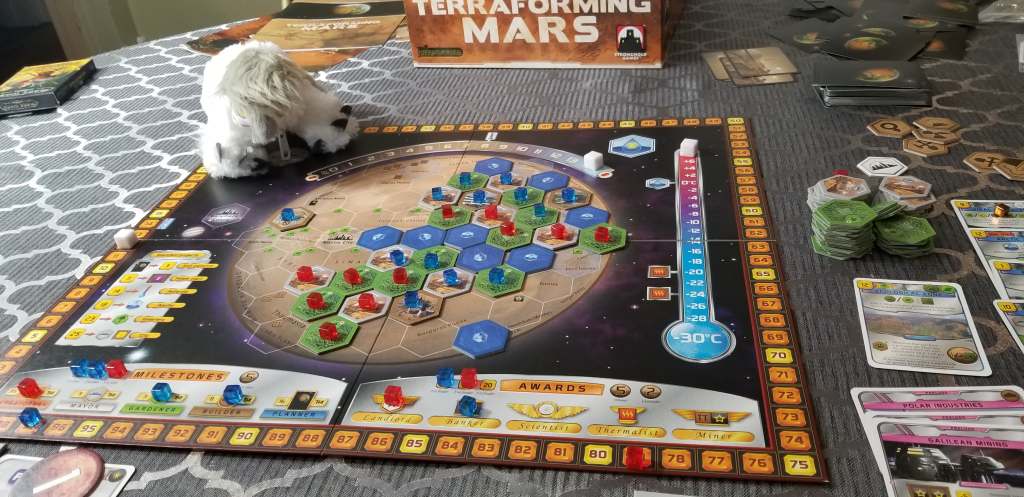
The components are one of the things that I never really warmed too for this game. I am a big fan of making components functional over pretty but Terraforming Mars may actually take this a little bit too far. That being said, the cards are extremely functional and you really don’t look at them that much. The board is much the same, simple, not ugly per se, but optimized for the game and not much to look at. Unfortunately this is something you do need to stare at a great deal as the game goes on, and neither the board nor tiles are particularly easy on the eye. It is my hope the 3d tiles tiles expansion (which I kickstarted) will fix this.

With the negative out of the way, let us move on to the positive; engine building. Terraforming Mars is probably the best engine building game around. Players play cards of great variety for the purposes of building their engine and placing tiles on the map. There are many ways to score points, but the primary means is manipulating the Martian atmosphere and placing greenery and cities on the map. Although the premise is actually quite simple, it is a relatively deep game when one gets into the nuances of optimizing one’s engine and when to switch from building resources to scoring and map control, which is why I like it to much.
Now there are two main ways to play Terraforming Mars, and that is by either drafting or just dealing out the starting cards and subsequent ones each turn. They each have their proponents and haters, and they usually don’t get along, but to be honest, I’m perfectly happy to play either way. For our 2 player game, we did not draft. While in larger player counts where players have time to plans their turns out while others take their actions, I find the draft does not add to the playtime substantially and may even reduce it because it allows players to further optimize their engines. In a 2 player game where there is very little downtime between turns and much less competition over map space, I find it nearly doubles the playtime, and is not as worthwhile. So I’ll play with or without it, depending on the mood of the table, but never with 2 players, and never without the preludes expansion.

Speaking of which there are several expansions for Terraforming Mars, all of which I believe to be different and worthy, but most of them I can take or leave, with the exception of preludes, which sets each player’s engine up much faster and gives you an idea of a strategy without having a massive blank slate. I recommend that even if you are brand new to the game, get the preludes expansion and never play without it. Colonies gives options to get resources if you don’t get the cards for them. Venus Next adds a whole bunch of other stuff to do. Hellas and Elysium gives alternate maps for other parts of mars. Turmoil is also great for the smug player who thinks they have the game figured out, but it adds significant playtime, complexity and player interaction to the game, so it’s not for everyone.
As I mentioned this has become one of my favorite games of all time, however I will not make a strong general recommendation, as this is an exemplar of a very specific type of game which I happen to enjoy a great deal. If you like engine builders, or strategy games with a smattering of theme but not too much, you likely enjoy this one. Players who prefer more thematic games, and who do not enjoy optimizing systems for their own sake will want to steer clear of Terraforming Mars, because for all it’s virtues, the theme is dry and it may be best game a what it does, but it doesn’t do much other than one specific thing.
Note: I do enjoy this game, but it depends entirely on who/how big of a group is playing. I generally do not enjoy games where people take forever to decide on what they’re doing because I prefer actively playing, and not spending a lot of time sitting around. It took Kage over a year to convince me to play this again after we first played it during a gaming convention once, because it had taken so long and was so dry and boring (and first play throughs can be really frustrating, especially when you feel like there’s no way you can possibly win). I will note that perhaps part of why I didn’t originally like the game is because the base (without preludes) is a little less structured in planning, and so much slower. I quite enjoy the game now, and look forward to playing it.
The Teal Dear
Game: Terraforming Mars
Designer: Isaac Fryxelius
Price: $62
Players: 2-5
2 player Scaling: Generally my preferred way to play
Playtime: 60-180 minutes depending onplayercount and drafting or no
Estimated Lifespan: Until Mars is terraformed
Average Play Frequency: 10x per year
Complexity: 4
Components: 3.5
Bang for Buck: 5
Value for Time: 4.5
Fun Factor: 5
Overall: 5
 Cardboard for 2
Leave a comment