
Today Amanda and I played a round of Ecos: First Continent. Ecos can best be described as a sort of “bingo for gamers”, with a little map building involved. I first found out about this game because I am a fan of designer John D. Clair’s card building games and I thought I would try out something else of his. I am glad that I did.
Laying Ecos out on the table is a fairly bland thing at first, there is very little of the board, which is built as gameplay goes on, on the table. Almost every component is top notch however, and as play continues the board will begin to look more interesting and detailed. There are not a lot of components, but each one is about as good as it can be. The tiles for terrain are solid and look nice, and the water tiles are slightly lower, adding a nice visual effect as the map gets built. The trees and mountains are meeples, which sounds weird at first but actually works very well, and the tokens for animals are thick and chunky cardboard, which I expect will last through all the play I can throw at it.
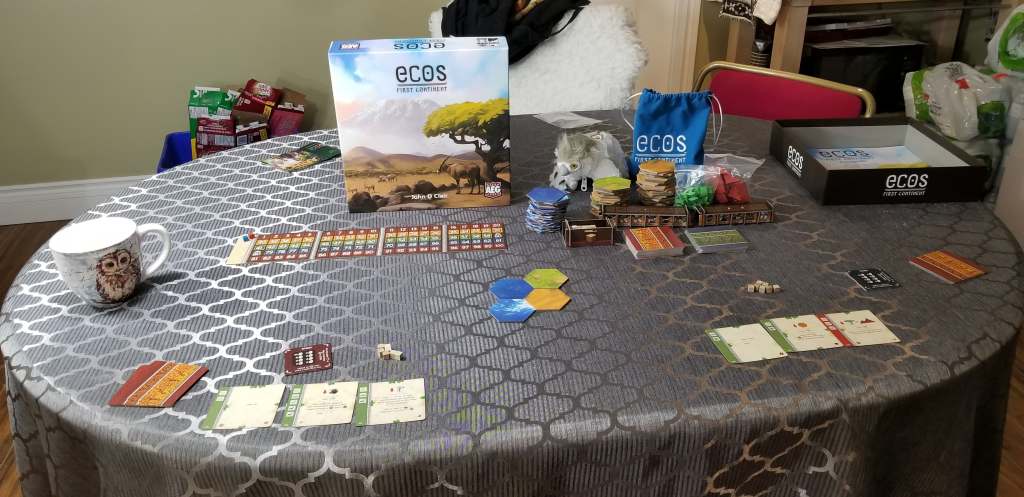
The cards are square, which normally would annoy me, but because of the way you make use of them it actually makes sense to have them shaped this way. My only real objection to the components is with the little cardboard boxes they made to store the animal tokens. They are actually cleverly designed and would probably work great in MDF or similar, but the die cut cardboard comes apart and does not hold its shape well with all the connections and thin pieces. Although they still more or less do what they’re supposed to, they look like garbage after assembly and don’t get better with time.
Gameplay is surprisingly complex, despite being driven by a simple bingo mechanism. The caller pulls a token and players match it with a symbol of their choice on one of their cards and when filled, the card activates with a declaration of “Ecos”. The cards have various effects from building the map to laying out animals, moving them around or scoring in some way. Players with no matching symbols rotate a card which is how one eventually gets and plays more cards.
The challenge is in both finding good combinations of cards and balancing that against the probability of them going off, as well as working off of the other players. Combo play and taking advantage of an opponent’s strategy is critical as players who plod along putting out gorillas at 4 points every few turns will rapidly find themselves feeding their opponent’s lion who scores 20 points in a single “Ecos” for eating them all.

The two player game is quite interesting and has both benefits and drawbacks, so I can’t say I recommend it more or less than a larger player count. Playing with two players is much more strategic, and requires a lot more attention be paid to your opponent’s card choices. The board will have a lot less on it and there will be less opportunities to work off of an opponent’s strategy, on the other hand it makes the players own choices more meaningful, and points more swingy. I find it equally fun in all sizes, and the simultaneous play in the nature of the game keeps it at a consistent pace for all player counts.
At the end of the day, whether or not one enjoys this kind of game will come down to whether or not the player likes managing the odds. There is a strong luck factor as well as a strong strategic and tactical factor to the game, so if you favor one or the other heavily, there are probably better games for you, but if you like a good mixture of both, then I highly recommend it.
Note: The bingo aspect of the game is quite fun because it’s very random in what potential symbols you’ll get, however, the token that you turn around if you do not have symbols does tell you how many of each are in the bag, so you can take that into consideration as you build up your strategy and the cards you want to use. Even if you’re losing this game is fun, and there have been times during our multitude of play throughs that someone has come from behind to a sweeping victory at the last moment.
The Teal Dear
Game: Ecos: First Continent
Designer: John D. Clair
Price: $50
Players: 2-6
2 player Scaling: Changes the game, but works perfectly
Playtime: 45-75 minutes
Estimated Lifespan: 20+ games
Average Play Frequency: Quarterly
Complexity: 3.5
Components: 4.5
Bang for Buck: 4.5
Value for Time: 4
Fun Factor: 4
Overall: 4

 Cardboard for 2
Leave a comment