
This afternoon marked our switch from euros into full on Amerithrash with Mage Wars Academy. I was introduced to this game via it’s big brother Mage Wars Arena, which despite being in my top 10 games of all time, doesn’t hit the tabletop very often anymore due it it’s excessive playtime. Academy hits a lot of the same notes while playing in a fraction of the time, and also acts as a decent introduction to the game for newer players, as the mechanics remain largely the same, with the exception of there no longer being a map to move across.
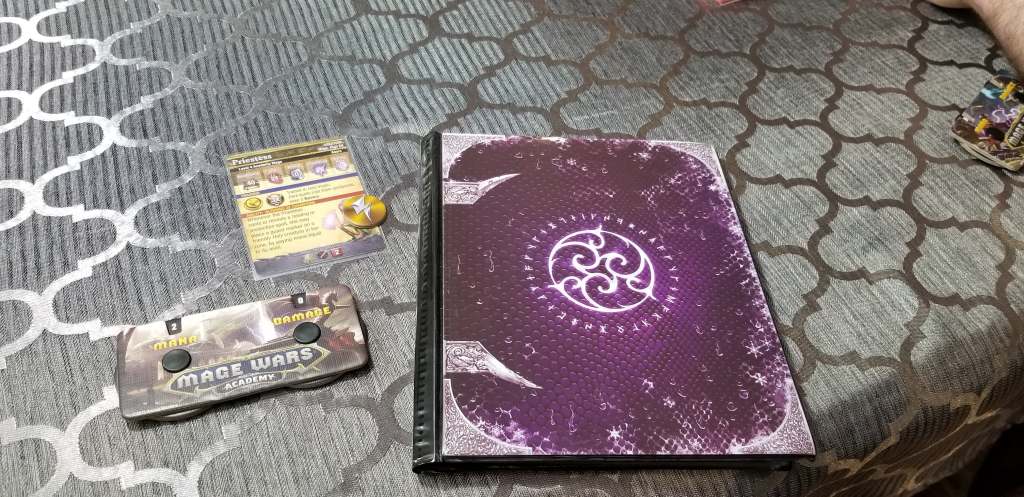
I’ll start with the components, the most obvious of which is the spellbooks which store your cards. They are more or less a small binder with card collecting sheets in them but serve their purpose well and look very sharp. The cards are a solid design as well, with clear symbology, good graphic design and generally excellent art, though like any card game, the art quality often varies from card to card.
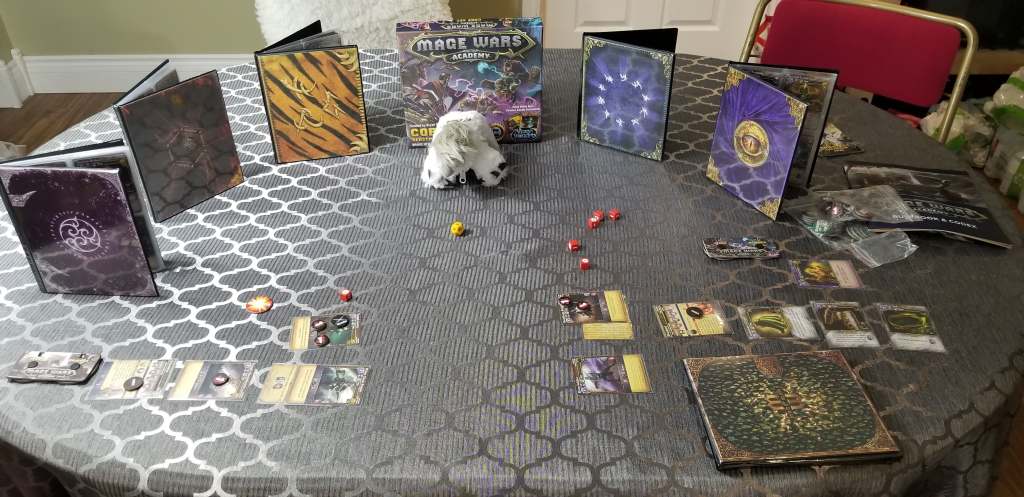
Although it has more to do with distribution method than the quality of the components, one of the best things about mage wars is that it was one of the earlier games to follow the “Living Card Game” model. With the exception of a few promotional cards, there is no need to spend excessive time hunting around shops or the internet to get the cards you want. When you purchase the Forcemaster set, you get all the forcemaster’s cards, plus duplicates and alternate cards to add in, as well as all the necessary tokens (of which there are many.) Being a former M:TG player and addict, I can certainly appreciate this, as there is no need to break the bank or hit Ebay to complete a collection.
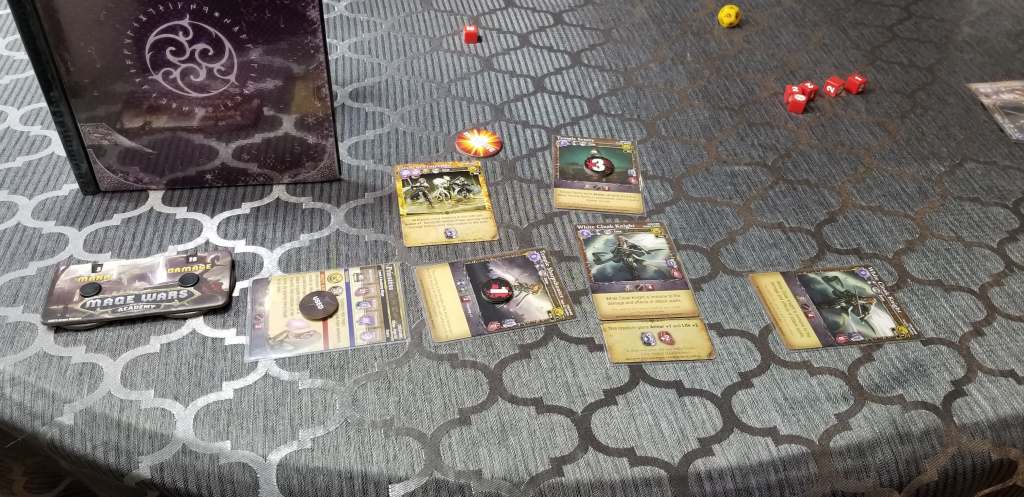
For the gameplay itself, players of Magic or similar games will find much to relate with here. You summon monsters to the field, enchant things, wear equipment and so on. The biggest thing that sets this apart from many similar monster summoning card games is that you have access to your entire deck at once in the form of your spellbook. There is absolutely no random factor to the order in which your cards come out, you pick what you want and when it comes out. This is not only great for making deck building more meaningful, but allows players to develop a strategy that does not rely on cards coming up when you need them or having your whole play ruined by a bad shuffle. There is still luck involved as attack damage and special effects are resolved via dice rolls, but there is a minimal variance, damage dice only vary from 0-2.
Players alternate actions between their wizards and summoned creatures, going back and forth until the end of turn and at the beginning of the next, where wizards gain mana and ready (untap) their cards and quick actions. Creatures are generally limited to attacking or guarding while wizards have a wide variety of actions from summoning more creatures and equipment, to attacking, enchanting or casting miscellaneous spells. If you have played any sort of monster summoning game before, the mechanics will be familiar, and if you haven’t, it’s not a bad place to start. This is also my preferred way or to start off anyone who is interested in the full board game, Mage Wars Arena. The largest difference between the games is that Academy is a lot more tactical, there is no way to put distance between yourself and your opponent so one needs to be more mindful of their rival’s moves or find their wizard knocked out of the fight before they have a chance to pull off a big combo.
Deckbuilding is pretty simple, and a lot more accessible than in similar games as there is no need to account for the randomness of card draws. You don’t need to add four copies of a spell to your deck unless you intend to use it four times, one copy will often suffice. The system for picking cards for each wizard is also simple and intuitive, and as long as you can count to 40, you won’t have a problem with it.
I would highly recommend Mage Wars Academy as my go to for either introducing players to one vs one card games, or as an affordable and attractive bridge between dueling card games and board games. As long as one player owns the base set, further players would need only purchase the wizard of their choice to have access to all that wizards cards, including some extras to deckbuild with. The default starting decks for each spellcaster are all also decent and playable, unlike the ones for Arena, which often needed extensive deckbuilding to become playable.
At the end of the day, I highly recommend this game to anyone interested in a “wizard vs wizard” experience and also suggest it you want it you get it soon, as Arcane Wonders has been tapering off support for it for the last 2 years.
Note: Today’s game went really quickly, but despite that, it was incredibly fun. When picking one of the multiple leaders, make sure you do an actual read through of all of their abilities, because while some might not have certain benefits (Priestess has no armour) they usually can counteract the other player’s benefit (or ability) with spells or something similar. While I also loved Mage Wars Arena I find that I like Mage Wars Academy better because it’s more tactical and you get into the meat of the game sooner, versus in Arena when you can duck around and hide.
The Teal Dear
Game: Mage Wars Academy
Designer: Aaron Brosman, Matthew Burch, Bryan Pope
Price: $40 for the base set, $18 per expansion
Players: 2-4
2 player Scaling: Designed for 2 and plays best that way
Playtime: 15-35 minutes
Estimated Lifespan: Permenant collection
Average Play Frequency: Monthly
Complexity: 3.0
Components: 4
Bang for Buck: 5
Value for Time: 5
Fun Factor: 5
Overall: 4.5
 Cardboard for 2
Leave a comment