
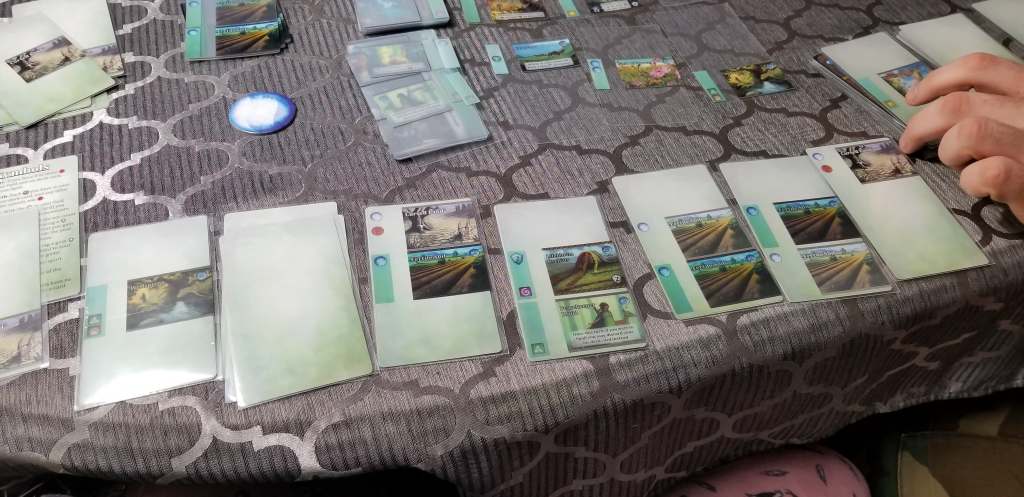
This most excellent Saturday brings us to Mystic Vale, where we face off as druids attempting to remove corruption from the land is this unique deck builder. Mystic Vale instantly stands out because of it’s nearly unique approach to deck building; instead of adding cards to the deck, you start with a complete deck which is modified by sliding clear plastic upgrades into the card sleeves, thus changing each card with each enhancement.
I was first introduced to Mystic Vale in a roundabout way as my friends introduced me to another of the designer’s games, Edge of Darkness. Edge of Darkness uses the same deck building mechanic but in a different way, and after playing it I looked up the designer, John D. Clair and found Mystic Vale through that search. I think Mystic Vale is definitely the best use of this system, although I have Dead Reckoning kickstarted, so we shall see which prevails in the end.

Game mechanics are actually quite simple, but due to a good variety of cards, there are many strategies available, with several paths to victory. Players draw cards by revealing and drawing their top card, always leaving the top card of their deck visible. When a player has 3 decay showing in their hand, they can push their luck and draw another card, but if a 4th decay is revealed on deck, the player misses their turn, this can be repeated as many times as a player is willing to risk it. Assuming they get their turn, the player plays their cards, purchases enhancements or “vales” (which are a card which stays in front of the player permanently) and then discards their hand and play goes to the next player. Play repeats until a set number of points, determined by the number of players, are scored from the general score pool. Players then total up their score and the druid with the most points is the winner.
As far as components go, they are excellent overall. There is really no middle ground with the transparent plastic cards, they either work or they don’t, and these do. The card art is decent and the graphic design is done well. Symbology on the cards is clear and colorful and the whole thing is tried together into a decent aesthetic. My only complaint is that the cards occasionally get a glare on them, but I think that had more to do with my lighting than anything else. Potential players may want to bear in mind, this is one of the few games that may actually benefit from having lower levels of light.
What mystic vale has going for it more than anything else is it’s system, which is both elegant and very versatile (there are a dozen or so expansions released to date). The fact that you not only build your deck but also build each individual card allows for considerably more opportunity for fun combinations and possibilities than deckbuilding alone. With variety though tends to a lack of balance and there is a not insignificant luck factor in whether cards that will combo well with what you have or not will turn up. There are no “bad” cards per se, but some certainly work better than others in combination.
We have 6 expansions to the game, all of which just add more cards with the exception of Conclaves. Conclaves is both a collectors box and a set of rules to determine which cards out of the ever growing collection one should use in a game, but to be frank and honest, we never use those rules. Firstly, they at least triple the setup and take down of a game that already has a lengthy takedown as far as card games go and secondly, they really don’t bring much balance, which is the only reason I would use them. Anyone who has played expandable deck builders like Dominion or Thunderstone knows that it is generally more fun to randomize what cards are used, or just use all of them a la thunderstone epic. Conclaves also adds the option to play with 6 players, which, even with the day/night rules, I do not recommend at all.
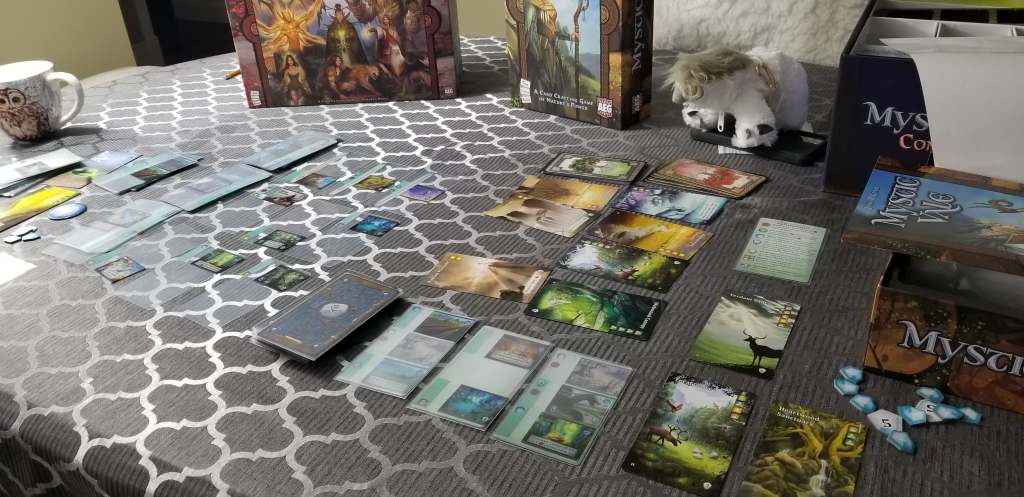
Two player scaling is nearly perfect and probably superior to larger games. I would go so far as to say that if I had 4 players, I would split them into two separate groups of two players each before playing a 4 player game (which is possible with enough expansions, especially Conclaves). There is very minimal player interaction in this game, and having more players only increases the play time and randomness, by cycling through available cards to purchase. A two player game allows for considerably more strategy in picking your combos, and makes it easier to keep track of your opponent so you can attempt to stymie them by snagging cards they might want before they can get them.
At the end of the day, this is one of those games that is going to come down to what sort of games you like to play. If you like deck builders, and want to try something different, then I would highly recommend it. If you don’t like the genre, then Mystic Vale, while different, is unlikely to change your mind, and I probably wouldn’t recommend it as a jumping in point. There are far better deck builders to use to wrap your head around the concept, but for those who like the genre and are perhaps feeling a little burnout, it’s a treat.
Note: Amanda would like to add that the imagery is gorgeous, well drawn out, and very alluring. Also it can be fun figuring out how to customize your deck and layer/stack the cards.
The Teal Dear
Game: Mystic Vale
Designer: John D. Clair
Price: $40
Players: 2-4 (6 with Conclaves expansion)
2 player Scaling: Better than all other player counts
Playtime: 15-20 minutes per player
Estimated Lifespan: 50+ games
Complexity: 2
Components: 4.5
Bang for Buck: 5
Value for Time: 4
Fun Factor: 4.5
Overall: 4.5
 Cardboard for 2
Leave a comment