
This fine evening brings us to Orleans, the bag drawing, engine building, worker placement-ish game that defies being placed in any sort of genre apart from “Euro”. In Orleans you build a team of workers, move around a map, gather goods, build guild houses and earn money, all in order to have the highest score at the end of the game. The play through for the review was for the base set. Orleans has several expansions, which either deeply change how the game is played or change it’s genre entirely. We may re-visit this one later with them for further review.
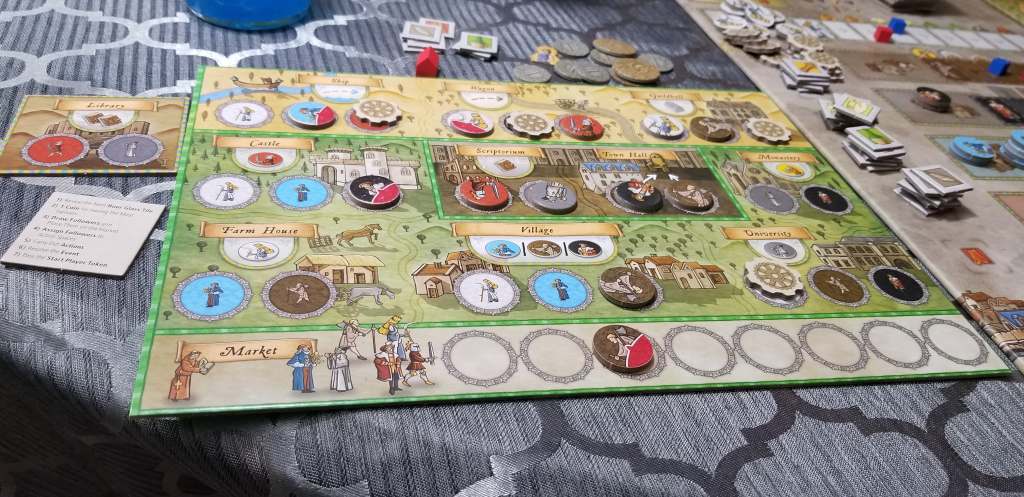
I have mixed feelings about the components of Orleans. In one hand, they all follow a very coherent theme, aiming to look like something you’d find as illustrations in a medieval bible or on the Bayeux tapestry. It’s all very well put together in terms of theme and aesthetic, on the other hand, it’s also kind of ugly. Not due to any fault of the artists, but just because that style is not all that appealing to my eyes. The pieces themselves are all extremely high quality and density cardboard with some wooden meeples, and have stood up to many playthroughs without any signs of visible wear.

The gameplay feels like a couple original ideas with some classic gameplay elements mashed together. There are a lot of working parts, all of which meld together fairly well. The turn starts with revealing the event, followed by players drawing their workers from their bag. The contents of the bag and the numbers drawn are determined by the players position on several tracks. Each player begins the game with the same four workers and will then place them on various positions on their board to perform certain tasks.
The majority of the tasks will net the player another worker for their bag and advance them on one of several tracks on the side board. Although the theme is a bare cover for the mechanics, the workers more or less make sense with what they can do. Merchants net you a new building, scholars move your knowledge track up, farmers produce goods etc. Other actions on your board include building guild houses, moving about the map and sending the workers off on special tasks for bonuses, which removes them from your bag.
After all the workers are out, the players resolve their choices one by one in turn order. After everyone passes the turn’s event is resolved and the process begins anew with a new first player. When the event deck runs out, players score their goods and money and their number of citizens and guild houses times a multiplier on the research track.
Orleans has a lot going for it, it has several more common systems integrated with it’s unique bag building system and they all integrate very well. The map movement is simple but effective, and so is the general engine building, however it is the bag building system that makes the game stand out. By making you able to manage probabilities, but not entirely plan out the outcome of your turn in advance, the game stays very fresh and keeps you thinking as you go. This may be a downside for those who like to math out their games and figure out their whole strategy in the first turn, but that is not my style in general, so it works well for me.
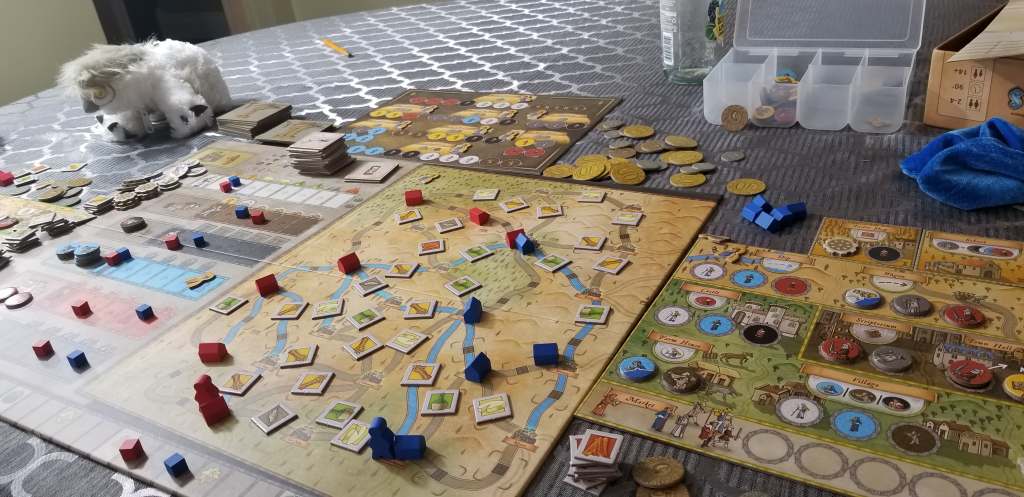
The two player game of Orleans is vastly different than the 4 player. The game does it’s best to scale by lowering the total number of resources based on the number of players, but this only levels it out to a certain degree. Certain things simply don’t play the same, the most obvious of which is the map. There are less goods to collect on it with 2 players, but it’s big enough that there is no real competition of placing guildhalls or fighting over the goods. The same is true of buildings and special projects, over which there is no real rush to grab, given that there are so many available and so few players to claim them.
The turns are also a lot faster in the 2 player game, and a full game can be knocked out within 45 minutes or so with experienced players. This makes it very appealing to me, and my preferred way to play, though with that being said, it scratches a different itch. The 2 player game is something of an engine building sandbox, you pick the way you want to go and you will more or less be able to execute it. The 4 player game tends to have players specializing a lot more, as the buildings and spaces used for each strategy now have to be split between 4 players instead of two. Turn order is also far more important in a 4 player game.
All in all I recommend Orleans as a two player game but should also stress that it scratches a different itch than playing with 3 or 4. There is a lot more freedom to choose how to run your engine, at the expense of a lot of the tension, so if engine building is your thing, it’s a great 2 player game, but if a tight map and player interaction if what you’re looking for, then I would reserve it for higher player counts.

Note: Amanda would like to add that this game is very fun for two players because what you want to do changes depending on what you pull from the bag and what goods appear on the map. You have to think while playing, and change strategies when necessary. Also don’t get so caught up in one aspect of the game that you forget about other point givers such as the golden people.
The Teal Dear
Game: Orleans
Designer: Reiner Stockhausen
Price: $55
Players: 2-4
2 player Scaling: Excellent, but a different game from 4 player
Playtime: 45-60 minutes
Estimated Lifespan: It will be part of my estate
Complexity: 3.5
Components: 4.5
Bang for Buck: 5
Value for Time: 4
Fun Factor: 5
Overall: 4.5
 Cardboard for 2
Leave a comment